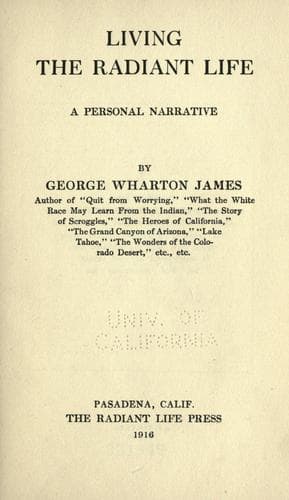
Living the Radiant Life: A Personal NarrativeJames, George Wharton
Religion
Living the Radiant Life: A Personal Narrative
James, George Wharton
Conduct of life
Shall I hesitate to render service because I myself am not perfect?
Shall I refuse to give the shivering and hungry beggar on the street a
twenty-five cent meal ticket because I myself am not free from debt?
Shall I refuse to guide the lost wayfarer because I myself do not know
all the winding pathways of life?
By no means! Let me do the best I may while I may, and seize every
opportunity that arises. It was a Christian minister that dared to
rebuke Father Damien by claiming that he was not immaculate in his
service to the repulsive and loathsome lepers of Molokai. And it was
Robert Louis Stevenson who showed that Christian minister what true
Christianity would have led him to say instead of what he did say.
Father Damien's ministry was self-sacrificing, noble, and divine, even
though,--granting for the moment the truth of the minister's
slander,--his service was touched of the earth, earthy. Yet the
beneficence and blessedness of it was so supremely above the smug,
self-satisfied, standing-aloofness of the "immaculate" ministerial
critic that Stevenson's colossal rebuke to the latter found perfect echo
in the heart of every decent man and woman throughout the world. Joaquin
Miller expresses the same thought in his beautiful and strong poem on
Father Damien when he says:
Why do ye not as he has done?
If we can do so much better than those we criticise, why, in the name of
heaven and suffering humanity, do we not go ahead and do it? Let us do
our best regardless of our own infirmities and weakness and the
consequent criticisms of others.
So I want to radiate to the needy and unworthy my readiness, nay, my
anxiety to serve them whenever and wherever I possibly can. And though
my service be not unmixed gold, though there be in it some of the dross
of imperfection, I would not withhold my hand on that account, but I
would serve the more readily and gladly in the hope and assurance that
by suffering with the needy and unworthy in their need and unworthiness
the fire of their pain and sorrow may help refine away the dross in me
and leave only that of pure gold.
"Give to the needy! _worthy_ or _unworthy_!" should be the battle cry of
him who wishes to be a blessing to his fellows, and the more unworthy
the needy are, the more loving and wise the service should be. When Walt
Whitman was shedding blessing, benediction, comfort, and joy on every
hand throughout the hospitals of Washington, he had little or no money
to give. He asked no questions when he went to the bedside of the sick
and dying soldier boys as to whether they were worthy or not. They were
needy and that was enough for him. He stayed and soothed their weary
hours by telling them stories, reading to them, writing letters home
for them, and in a thousand and one little and big ways seeking to make
their sick beds more tolerable during the long hours of enforced
confinement.
Public-domain text, read in full here on John Shaqi.
Reviews
Reviews
No reviews yet
Be the first to share your thoughts on this work.
Elsewhere in the archive
Join the Discussion
Join the discussion
Sign in to leave a comment or review.
Sign InorCreate an account