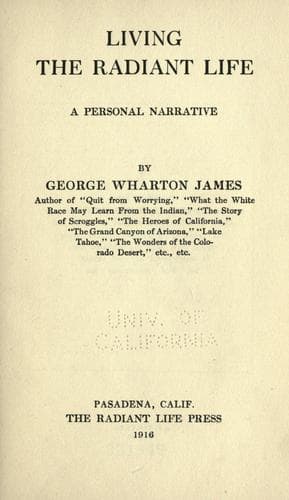
Living the Radiant Life: A Personal NarrativeJames, George Wharton
Religion
Living the Radiant Life: A Personal Narrative
James, George Wharton
Conduct of life
In her sculptured fountain at the Panama-Pacific Exposition, Mrs. Harry
Payne Whitney expresses the same idea, but even more forcefully than
does the picture. Here are thirty-seven figures nearly all intent upon
reaching their goal of happiness. They cannot even see what it is. Yet
the eagerness depicted upon the faces, in the straining attitudes, the
strenuous striving in that one direction, all typify the desire, the
intentness, the resolute pursuit of happiness. Then, alas, when the
doors are reached, they are both found closed, guarded by Assyrian and
Egyptian figures, that suggest the occult mystery of the beyond, and
that look down sternly and unyieldingly upon the two figures at their
feet, long strivers, evidently pleading for the admission that is denied
them. There are two definite, distinct, and different ways in which
these two allegories can be interpreted. One is that mankind ever lives
in the world of the senses, pursuing the gratifications of the now, the
feastings, the drinkings, the carousings, the pleasuring, the wantonings
of the sense-life, the sensual life, and that such a pursuit is ever
doomed to failure, for man--the spiritual, created in God's own
image--can never be satisfied with the temporary things of earth and
sense.
The other interpretation is that man is ever seeking for some _far-off_,
great, _extraordinary_ pleasure, joy, or satisfaction, something in the
future, rather than living in the smaller joys of the _now_. The child
longs to be the youth or maiden, enjoying "sitting up at nights," "going
to parties," "eating candies," "going out with the boys," "smoking like
a man"; the youth eagerly works for the time when he shall be his own
master, control his own business; the maiden, have her lover, marry
successfully, become the mistress of her own house; the grown man looks
forward to and works desperately for the time when he shall have "made
his pile," and the woman to "an assured place in society." These, and a
thousand and one "_pursuits_" engage men and women.
Public-domain text, read in full here on John Shaqi.
Reviews
Reviews
No reviews yet
Be the first to share your thoughts on this work.
Elsewhere in the archive
Join the Discussion
Join the discussion
Sign in to leave a comment or review.
Sign InorCreate an account