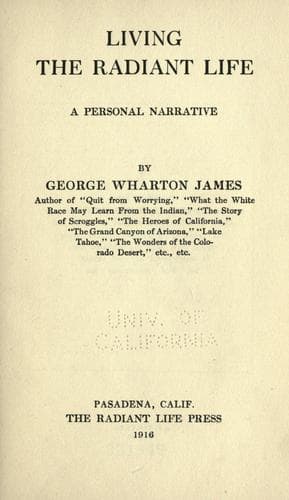
Living the Radiant Life: A Personal NarrativeJames, George Wharton
Religion
Living the Radiant Life: A Personal Narrative
James, George Wharton
Conduct of life
In my own life I am eagerly desirous to radiate the opposite of both of
these conceptions. I certainly do not wish to belong to the class
pictured in Christ's parable of the rich man; he who thought only of the
so-called good things of this life which he would enjoy now--he who
said: "Let us eat, drink, and be merry, for to-morrow we die." The
slightest observation of life, of the men and women one meets daily,
soon convinces one of the hollowness, the dissatisfaction, the
incompleteness of all earthly things. The subject is too trite to need
any amplification. Yet, the wonder of it is, that, in spite of this
fact, the great majority of people still thus strive for wealth, place,
power, honor, social success, possessions, attainments. Why is it that
this _ignis fatuus_ has such power of allurement? Why is it that men
and women are so foolish, so slow to rule their actions by their own
inner spiritual awakenings, rather than the habits and fashions followed
by others?
I have no desire or ambition for fame, for honor, for success, for
place, for power, _as such_. They are useless to me save as I may use
them for the benefit, the happiness, the pleasure of my fellows. I am
slowly awakening to the realization of what I believe now to be a primal
fact, viz., that all a man can really hold and enjoy in his living hand,
in his soul, in his life, is that which he gives away, shares,
distributes among his fellows.
Elsewhere I have quoted Joaquin Miller's lines from _Peter Cooper_:
For all you can hold in your dead, cold hand,
Is what you have given away.
I now wish to radiate my belief in the enlargement of that idea as
stated above. Even knowledge can give no real satisfaction unless
shared, given to others; the joy of a picture owned is lost unless
others can enjoy with you. In other words, the possession of anything
_for self alone_ is destructive of happiness. One learns slowly but
surely that even in these things of the mind and the soul:
That man who lives for self alone
Lives for the meanest mortal known.
CHAPTER XXI
RADIANCIES OF EXTREMES
Life is made up of extremes and everything that comes between them.
There is the North Pole and there is the South Pole. There is the heat
of the fiery furnace and the cold of the Arctic Zone. There is the
height of heaven and the depth of hell; the voice of the thunder and the
whisper of the gentle zephyr.
Man is a singular being. He is as diverse as is the manifold face of
Nature upon which he gazes. His likes and dislikes are many and varied.
Men of equal intelligence and equal powers differ in their ways of
looking at the same thing. The poet Browning effectively states this
when he says:
Ten men love what I hate,
Shun what I follow, slight what I receive;
Ten, who in ears and eyes
Match mine.
Public-domain text, read in full here on John Shaqi.
Reviews
Reviews
No reviews yet
Be the first to share your thoughts on this work.
Elsewhere in the archive
Join the Discussion
Join the discussion
Sign in to leave a comment or review.
Sign InorCreate an account