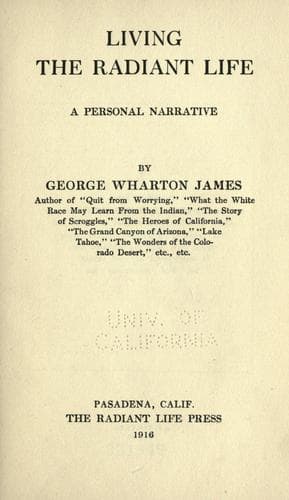
Living the Radiant Life: A Personal NarrativeJames, George Wharton
Religion
Living the Radiant Life: A Personal Narrative
James, George Wharton
Conduct of life
For centuries the human mind has been afraid, disturbed, distressed, at
the thought of death; the uncertainty of the beyond; "shall we know each
other there?" and the thousand and one questions that have arisen as to
what life, if any, there is beyond the grave. Years ago, in my own
innerness, all sense of fear, of disturbance, of distress at the thought
of death vanished, never again to appear. I have no resentment at the
thought of death, either for myself, or those I love. I expect it for us
all, and am neither surprised nor hurt when it comes. There may be the
sense of physical loss, but that is all. There is no sense of _real_
loss of anything except the temporal, the physical, that which, in the
very course of Nature, must pass through the change we call Death.
Hence I feel I have definite and positive radiancies upon this subject,
which I am assured will bring comfort and peace to those who can enter
into the spirit of them, and accept the same assurances that have come
to me.
The first of these that I would radiate with clearness and fullness is
that _man is a spiritual being and not physical_. Much of the fear,
dread, distress, pain of death has come from the mistaken belief that
man is physical. Death has come and robbed us of the life of the
physical. The flesh has become cold, inanimate, lifeless, therefore dead
and lost to us. The mother has grieved herself into sickness and a
ruined life because of the death of her babe. Husbands have wept long
for the wives they thought they had lost. Sorrow, grief, sadness,
woe--these seem the natural accompaniments of death. Our customs, our
language, our literature, our poetry, our art, are full of the
expressions of this thought--the trappings of woe, the solemn
countenance, the hushed voice, the somber garments, the widow's weeds,
the black band of bereavement, the hearse, the funeral marches, the
watch of the dead, the lighted candles, the solemn funeral addresses,
the tears, the grief that will not be comforted, all speak of the
sadness attributed to death. Tennyson's _In Memoriam_, Browning's _La
Saziaz_, and hundreds, thousands, of lesser poems have been written on
the woe, the grief, the cruelty of death.
While I long for the physical presence of my beloved ones as much as do
other men, I would radiate my belief, my restful assurance, in the love
that exists, _persists_, _lives_, after what we call the death of the
body, and that, therefore, to me, save for the loss of the physical
presence, there is absolutely no death, no need for sorrow, grief, pain,
or woe.
As birth itself is a death of the embryonic life, so is death a birth
into the life beyond--the life of the spirit, the life, free,
unhampered, unhindered by the flesh. Browning expresses it perfectly in
his wonderful _Pisgah Sight_, where he stands and looks "over Jordan"
into the Promised Land:
Public-domain text, read in full here on John Shaqi.
Reviews
Reviews
No reviews yet
Be the first to share your thoughts on this work.
Elsewhere in the archive
Join the Discussion
Join the discussion
Sign in to leave a comment or review.
Sign InorCreate an account