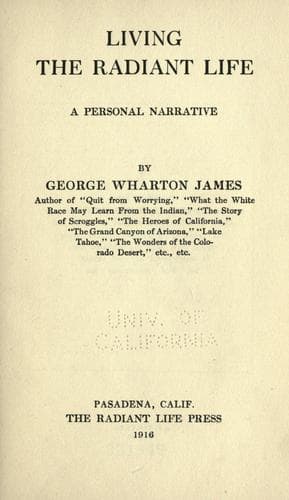
Living the Radiant Life: A Personal NarrativeJames, George Wharton
Religion
Living the Radiant Life: A Personal Narrative
James, George Wharton
Conduct of life
Do not radiate discontent, therefore, but radiate a glorious, buoyant,
exuberant contentment. Think of the books we have to-day, as compared
with those possessed by people who lived a few hundred years ago--the
poems, the dramas, the essays, the histories, the novels, the accounts
of adventure and travel, the revelations of science. Think how cheap
they are, how easy to obtain. Think of the public libraries established
in almost every city, town, and village of the civilized world. In many
states they have now established a method by means of which the library
systems may become county-wide in their influences instead of confined
to the cities and towns. Books are being sent to the remotest farmhouse,
to the shack of the lumberman, the moving home of the sheep-herder, the
log hut of the miner, anywhere, everywhere that a human hand is seen
stretched forth for a book, the new library system seeks to reach.
Think of the music of to-day! The great bands, the marvelous orchestras,
the soul-inspiring choruses, the wonderfully equipped opera companies,
the cheapness of the organ and piano, the universality of the
graphophone, with its records of music of every character that can be
heard in the humblest home.
Think of the multiplication of the opportunities for hearing the drama,
some good, some indifferent, some bad, but all more or less revealing
artistic power and calling forth the satisfaction of the onlookers.
Think of the spread of educational opportunities, the public schools,
the colleges, the universities, the correspondence schools, the women's
clubs and leagues. I went through a high school the other day that was
ten times better equipped for the higher education, as far as it went,
than the universities were a hundred years ago.
Think of the ease with which we travel--electric cars, railway trains,
automobiles, flying machines.
Think of the annihilation of distance in conversing with our friends,
the telephone, the telegraph, the telepost, the wireless.
Think of the opportunities of enjoyment and education offered to the
poor in our large cities by means of the parks, the children's
playgrounds, the free museums, and the art galleries.
Think of the improvements during late years in the conditions of home
life--the application of gas and electricity for lighting, heating,
cooking, ironing, and, now, even for sweeping and cleaning up.
Think of the improvements of the condition of lives of our farmers and
their laborers in the remote districts. Little by little the conditions
of life are being made easier for them. Labor is being lightened and the
hours shortened, uncertainties are being eliminated, results made more
sure.
Public-domain text, read in full here on John Shaqi.
Reviews
Reviews
No reviews yet
Be the first to share your thoughts on this work.
Elsewhere in the archive
Join the Discussion
Join the discussion
Sign in to leave a comment or review.
Sign InorCreate an account