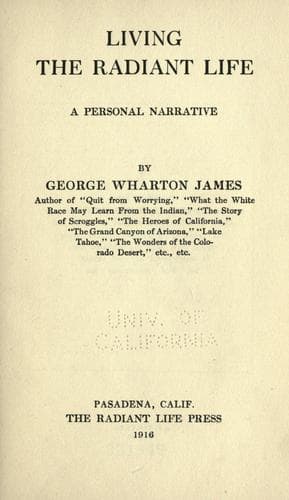
Living the Radiant Life: A Personal NarrativeJames, George Wharton
Religion
Living the Radiant Life: A Personal Narrative
James, George Wharton
Conduct of life
Think of the growing spirit of freedom and true democracy, of
brotherhood and comradeship that are welding the world together in the
bonds of humanitarian brotherhood; treaties between nations,
federations of nations, world's fairs, the Red Cross movement, The Hague
Peace Tribunal, arbitration instead of war, and agitation for the
reduction of armies and navies.[D]
[D] This was written prior to the breaking out of the war of 1914-15,
when "hell was let loose in Europe." Yet I do not feel inclined to
change one single line of what I then wrote. During 1915, I was engaged
speaking daily to large audiences at the Panama-Pacific Exposition in
San Francisco--I estimate that I addressed not less than 300,000 people
during that time. In many of these addresses I expressed my thoughts
about the hideousness, the needlessness, the waste, the devilishness of
war, with open frankness, and without a single exception my
denunciations of the system of war were received with hearty applause. I
refer to this merely as an index as to what I believe is the general
thought of all intelligent people on the subject. All except war-mad and
war-hypnotized people hate war and desire to see it abolished, and the
higher standards of brotherly and amicable conference and equitable
adjustment of difficulties take its place. That nations were urged into
the European conflict is no proof that they love war. It is rather a
proof that they hate war enough to die to make future wars impossible.
This, I sincerely hope and confidently expect, will be the tendency of
the result, if not an actually accomplished result.
One has but to study the changes that have taken place in our
civilization since Dickens began to write, for instance, to see how
wonderfully the world has progressed. He wrote _Nicholas Nickleby_ to
call attention to the horrible abuses existent in boys' boarding
schools, where boys, who for any reason were desired out of the way at
home, were put in charge of human fiends in the guise of
"schoolmasters." Step-children, heirs who were in the way, natural
children, and those whose parents had no natural affection for them,
were put into these dens, and so cruelly abused that they often died;
and at the best they dragged out their miserable existence afraid of
what each hour of the day might bring forth and finding only in their
troubled sleep the relief from the active cruelties they were made to
bear.
_Little Dorrit_ graphically pictured the horrors of the "prison for
debt" system, and in the wonderfully painted character of Little
Dorrit's father, Dickens showed how every human trait and feeling, every
noble passion and emotion was dwarfed, twisted, distorted, and perverted
by the action of this unnatural, cruel, and monstrous law.
Public-domain text, read in full here on John Shaqi.
Reviews
Reviews
No reviews yet
Be the first to share your thoughts on this work.
Elsewhere in the archive
Join the Discussion
Join the discussion
Sign in to leave a comment or review.
Sign InorCreate an account