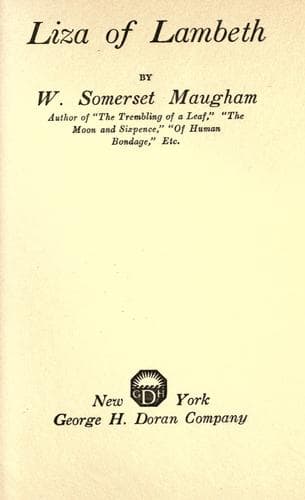
Liza of LambethMaugham, W. Somerset (William Somerset)
General
Liza of Lambeth
Maugham, W. Somerset (William Somerset)
Working class -- England -- Fiction
'Never mind, old chap!' Liza would answer, herself half crying, 'it
can't be 'elped, so we must jolly well lump it.'
But notwithstanding all their precautions people in Vere Street
appeared to know. First of all Liza noticed that the women did not
seem quite so cordial as before, and she often fancied they were
talking of her; when she passed by they appeared to look at her, then
say something or other, and perhaps burst out laughing; but when she
approached they would immediately stop speaking, and keep silence in a
rather awkward, constrained manner. For a long time she was unwilling
to believe that there was any change in them, and Jim who had observed
nothing, persuaded her that it was all fancy. But gradually it became
clearer, and Jim had to agree with her that somehow or other people
had found out. Once when Liza had been talking to Polly, Jim's
daughter, Mrs. Blakeston had called her, and when the girl had come to
her mother Liza saw that she spoke angrily, and they both looked
across at her. When Liza caught Mrs. Blakeston's eye she saw in her
face a surly scowl, which almost frightened her; she wanted to brave
it out, and stepped forward a little to go and speak with the woman,
but Mrs. Blakeston, standing still, looked so angrily at her that she
was afraid to. When she told Jim his face grew dark, and he said:
'Blast the woman! I'll give 'er wot for if she says anythin' ter you.'
'Don't strike 'er, wotever 'appens, will yer, Jim?' said Liza.
'She'd better tike care then!' he answered, and he told her that
lately his wife had been sulking, and not speaking to him. The
previous night, on coming home after the day's work and bidding her
'Good evenin',' she had turned her back on him without answering.
'Can't you answer when you're spoke to?' he had said.
'Good evenin',' she had replied sulkily, with her back still turned.
After that Liza noticed that Polly avoided her.
'Wot's up, Polly?' she said to her one day. 'You never speaks now;
'ave you 'ad yer tongue cut aht?'
'Me? I ain't got nothin' ter speak abaht, thet I knows of,' answered
Polly, abruptly walking off. Liza grew very red and quickly looked to
see if anyone had noticed the incident. A couple of youths, sitting on
the pavement, had seen it, and she saw them nudge one another and
wink.
Then the fellows about the street began to chaff her.
'You look pale,' said one of a group to her one day.
'You're overworkin' yerself, you are,' said another.
'Married life don't agree with Liza, thet's wot it is,' added a third.
''Oo d'yer think yer gettin' at? I ain't married, an' never like ter
be,' she answered.
'Liza 'as all the pleasures of a 'usband an' none of the trouble.'
'Bli'me if I know wot yer mean!' said Liza.
'Na, of course not; you don't know nothin', do yer?'
'Innocent as a bibe. Our Father which art in 'eaven!'
''Aven't been in London long, 'ave yer?'
They spoke in chorus, and Liza stood in front of them, bewildered, not
knowing what to answer.
Public-domain text, read in full here on John Shaqi.
Reviews
Reviews
No reviews yet
Be the first to share your thoughts on this work.
Join the Discussion
Join the discussion
Sign in to leave a comment or review.
Sign InorCreate an account