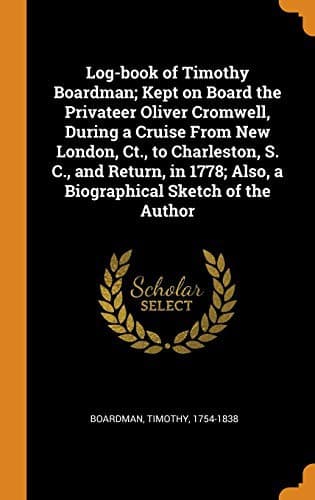
Log-book of Timothy Boardman: Kept on Board the Privateer Oliver Cromwell, During a Cruise from New London, Ct., to Charleston, S. C., and Return, in 1778; Also, a Biographical Sketch of the Author.Boardman, Timothy
History
Log-book of Timothy Boardman: Kept on Board the Privateer Oliver Cromwell, During a Cruise from New London, Ct., to Charleston, S. C., and Return, in 1778; Also, a Biographical Sketch of the Author.
Boardman, Timothy
Oliver Cromwell (Ship); United States -- History -- Revolution, 1775-1783 -- Naval operations; United States -- History -- Revolution, 1775-1783 -- Personal narratives
Timothy Boardman's supreme interest in life, however, was in his loyalty
to Christ, and his intense desires were for the extension and full
triumph of Christ's kingdom. The revivals which prevailed in the early
part of the century and the consequent great expansion of aggressive
Christian work, were in answer to his life-long prayers, as well as
those of all other Christians; and he entered heartily, from the first,
into all measures undertaken for the more rapid spread of the gospel. He
was greatly interested in the formation of the American Board of
Commissioners for Foreign Missions, and read the _Missionary Herald_,
with interest from its first publication, until his death. The formation
of the Bible Society, Tract Society, Seaman's Friend Society, Sunday
School Society, American Home Missionary Society, etc., engaged his
interest, and received his support. He made himself an honorary member
of the A. B. C. F. M. near the close of his life, in accordance with the
suggestion of his sister Sarah, whom he greatly valued, the wife of Rev.
Joseph Washburn, and afterward of Dea. Porter, both of Farmington, Ct.,
by the contribution to Foreign Missions, at one time, of one hundred
dollars.
In social and domestic life, he was a son of the Puritans and of the
Connecticut type. He exacted obedience, and somewhat of reverence
from his children. They did not dare, to the last, to treat him with
unrestrained familiarity. His wife and children stood, waiting at their
chairs, until he was first seated at the table. He gave his children a
good education for the time, sending them to "Master Southard." His
habitual temper of mind was one of deep reverence toward God. He sat in
awe during a thunder storm, and a cyclone which passed over his home
deeply impressed him. His letters abound in affectionate and in
religious sentiments. He was scrupulous in the observance of the
Sabbath; required it of his children, and he expected it of the stranger
within his gates. The family altar probably never failed from the day he
first entered with his newly married wife, into their pioneer home, amid
the forests, till his death. He was solemn, earnest and felicitous in
prayer. The atmosphere of his home was eminently that of a christian
household. Two of his four sons became officers in their churches, and
also both his sons-in-law. Four of his grandsons entered the Christian
ministry, and a granddaughter is the wife of a clergyman. Those who
regard the Puritans in general, as too severe in industry, in frugality,
in morals and in religious exercises, would have regarded him as too
exacting in all these directions. He certainly could not on one hundred
and fifty acres of land, which he found wild, and not all of it very
good, have reared a large family, and supported public institutions as
he did; have given each of his sons at settlement in life, six hundred
dollars, and left to each at his death, eight hundred, if he had not
Public-domain text, read in full here on John Shaqi.
Reviews
Reviews
No reviews yet
Be the first to share your thoughts on this work.
Join the Discussion
Join the discussion
Sign in to leave a comment or review.
Sign InorCreate an account