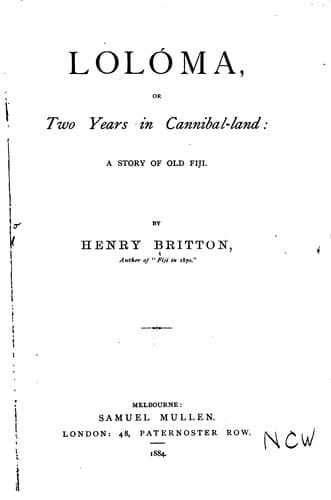
Lolóma, or two years in cannibal-land: A story of old FijiBritton, Henry
History
Lolóma, or two years in cannibal-land: A story of old Fiji
Britton, Henry
Fiji -- Social life and customs -- Fiction; Shipwrecks -- Fiction
The sun rose like a molten globe shorn of his beams and powerless to
outstare a man, but giving a pale effulgence like that of the moon. As
the spectral light crept up towards the zenith it disclosed a sight
which has often appalled stout hearts, though forming in itself a
magnificent spectacle—a storm-tossed sea breaking in mad fury upon the
South Sea reef—one of those mighty fabrics of coral which myriads of
tiny architects, the conquerors of the ocean surge, have raised as
natural breakwaters for all the islands of the Fijian archipelago.
The gale was hurrying us with uncontrollable power upon Viti Levu, the
largest island of the group, and its girdle of coral, on which the
furious sea was breaking in magnificent desolation. The sound came to us
now like a roar of fierce anger, now with a measured dirge-like tone,
and now in melancholy strains mellowed by distance, tristfully surgent
like those of an Æolian harp. These reefs usually encircle the islands
at a distance of from half a mile to two miles. Within the barrier the
water is as smooth as a lake, but the trade winds, which blow for nine
months in the year upon the shore, send the long rollers of the Pacific
against the reef, which varies from 5ft. to 30ft. in width. Dashing upon
this impregnable barrier, they rise in columns of rosy foam often to a
height of from 20ft. to 50ft., and, glittering in the rays of the
tropical sun, fall like obelisks of diamonds. A long line of silent
ripples is often at first the only indication of the presence of one of
these spines of coral and volcanic rock; then the rollers come against
them with a sound like a thunder-clap, and the waters, broken into
milk-white foam, hurry along the side with wonderful impetuosity, like
an immense jet of vapour, until, meeting with a greater obstruction, a
column is thrown high into the air, and forming an aqueous arch, bursts
suddenly into spray.
As we neared what we felt to be our doom—for it was impossible to alter
the course of the schooner, which continued to be driven before the wind
under a storm-jib—the captain told us we had two chances, though very
small ones. One was to be driven in at the reef-opening, which is
usually found opposite a river or creek, and where the water is
generally of sufficient depth to admit of the largest vessel entering.
The other was to jump the barrier. If the vessel took the reef in a
narrow place it was possible for her, by great good fortune, to ride
clear over it on the back of a wave into smooth water, but the chances
were ten thousand to one that she would be caught on the obstruction, or
perhaps be dropped by a receding billow on a pointed coral patch and be
shivered to fragments.
Public-domain text, read in full here on John Shaqi.
Reviews
Reviews
No reviews yet
Be the first to share your thoughts on this work.
Join the Discussion
Join the discussion
Sign in to leave a comment or review.
Sign InorCreate an account