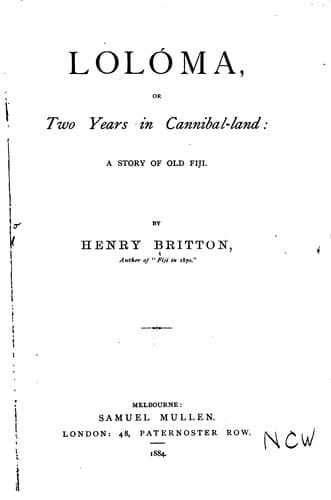
Lolóma, or two years in cannibal-land: A story of old FijiBritton, Henry
History
Lolóma, or two years in cannibal-land: A story of old Fiji
Britton, Henry
Fiji -- Social life and customs -- Fiction; Shipwrecks -- Fiction
“To be killed and eaten,” added the mate, “is not the worst there is to
fear, either. These wretches sometimes torture their helpless victims in
a fiendish way. Only a year ago an English sailor, who had been
hospitably received on one island, got wrecked on another in a canoe
while endeavouring to reach a ship in the offing, and he had not the
good fortune to be clubbed outright. His eyelids were cut away by the
sharpened shell of the pearl-oyster, and he was then bound to a tree
with his exposed orbs turned to the full glare of the sun. When the poor
fellow was perfectly blind they skinned the soles of his feet, and then
tormented him with firebrands to make him jump about in that wretched
condition.”
For the present we were safe, however. The hurricane and the tidal wave
had destroyed the villages on the coast where we were driven ashore, and
the terrified inhabitants had fled inland, leaving the strand strewn
with their household gods, and littered with uprooted trees and
fragments torn from the dense vegetation.
Soon the storm-wrack cleared away, the heavens were a vault of blue
faintly laced with thin transparencies of clouds, the sun appeared in
all his splendour, playing on the still waters within the reef with a
myriad flashing colours, while the rainbow-tinted coral forest seemed to
wave gracefully in the shades and gleams as some bright-coloured fish
lazily stirred the thick subaqueous undergrowths. A soft pearly haze
rested on the purpling ocean, and it was difficult to believe that an
awful tempest had so recently swept over the peaceful scene. When night
came, the full moon rose radiantly in the east, throwing a broad track
of silver across the crisp wavelets, and shedding a soft halo round the
sad wreck of the Molly Asthore, so plainly doomed no more through
rolling seas to ride again.
The neighbouring thicket in which we had made some slight timorous
explorations, skirted a tropical forest in which the trees and tangled
undergrowth were so closely packed that the hurricane had done but
little damage except upon the seaward edge. The cocoanut trees, which
are not very firmly rooted, and have at the top of their high
cylindrical stems a heavy plume of leaves, among which the nuts nestle
in luscious clusters, had suffered severely wherever they were exposed
to the fury of the gale. The bread-fruit trees, which are of sturdy
growth and well-balanced with thickly-fruited branches, were not much
injured.
Public-domain text, read in full here on John Shaqi.
Reviews
Reviews
No reviews yet
Be the first to share your thoughts on this work.
Join the Discussion
Join the discussion
Sign in to leave a comment or review.
Sign InorCreate an account