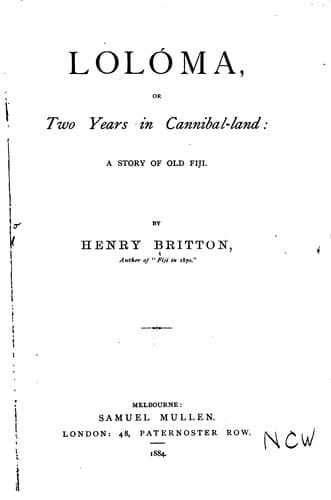
Lolóma, or two years in cannibal-land: A story of old FijiBritton, Henry
History
Lolóma, or two years in cannibal-land: A story of old Fiji
Britton, Henry
Fiji -- Social life and customs -- Fiction; Shipwrecks -- Fiction
Towards evening our last shot had been expended, and the enemy held off,
waiting for the cover of darkness to make a grand rush and finish us
with the club. Ovens were already being prepared for the approaching
cannibal feast, so sure were they of the result. The captain remarked
that among the insulting fire of words the natives kept up he could
distinguish that they were bespeaking the three of us joint by joint.
They were also preparing the three kinds of vegetables always eaten with
bokola, as baked human flesh is called. These I afterwards learned were
the leaves of the malawathi, the tudano, and the borodina. The two
former are middle-sized trees, growing wild. The borodina is cultivated;
it is a bushy shrub, seldom higher than 6ft., with a dark, glossy
foliage, and berries very much like tomatoes, which have a faint
aromatic smell, and are sometimes prepared like tomato sauce. These
plants are wrapped round the several joints of the prepared human body,
and baked with them on the hot stones of the cannibal oven.
When it became apparent that our capture by club and spear was only a
question of an hour or two if we remained on the schooner, we determined
to make good our retreat to the friendly shelter of the forest. As soon
as night fell we quietly slid down a rope at the stern into the sand,
and wading some distance into the sea, travelled along the coast-line
until we were well out of reach of the cannibal horde. Then we struck
into the woods and concealed ourselves in a vast cabin formed by the
roots of a baka.
This tree resembles the famous banyan of India. Its branches are propped
up by aerial roots which run along the ground, assuming strange shapes,
and forming a fantastic maze, which is perfectly indescribable in its
convolutions. At first a parasite on other trees, it soon acquires such
dimensions that it sucks all their sap, when they die, and it then has
to draw its nourishment from the soil. The crown of the giant baka,
upborne on air roots, expands into a cloud of foliage frequently 150ft.
in diameter, or 450ft. in circumference. This hanging garden of
vegetation is decorated with pendant cacti and brilliant orchids.
Gorgeously-plumaged parrots hang among the boughs nibbling at the
blossoms, gem-like lizards bask on the trunk, and innumerable insects
hum in chorus in the foliage. Bush-ropes of every size and degree of
pliancy climb and twist about, running from tree to tree. Some stately
trunks, supported by these natural stays and braces, looked like the
masts of a fleet at anchor. The mighty baka forms an awe-inspiring
object, and is frequently made sacred to priestly incantations. Such a
tree having this character is never approached by Fijians not in the
priestly office, so that our place of concealment seemed very secure.
Public-domain text, read in full here on John Shaqi.
Reviews
Reviews
No reviews yet
Be the first to share your thoughts on this work.
Join the Discussion
Join the discussion
Sign in to leave a comment or review.
Sign InorCreate an account