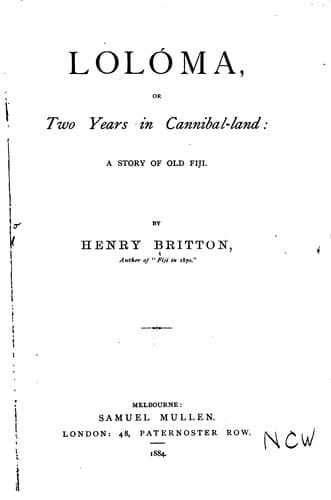
Lolóma, or two years in cannibal-land: A story of old FijiBritton, Henry
History
Lolóma, or two years in cannibal-land: A story of old Fiji
Britton, Henry
Fiji -- Social life and customs -- Fiction; Shipwrecks -- Fiction
Aided by our friends, it was easy for us to remain in concealment until
a good opportunity for getting away from the officers of the law
presented itself. I had succeeded in securing my companion’s liberty,
but I had not only broken the law and made myself liable to the same
cruel punishment from which I had saved him—I had compromised my father,
whose name I had used in the transaction with the turnkey. I determined
that, if possible, I would leave the colony. Whitely preferred making
his way to a relation in the country.
As luck would have it, while I was in concealment a sandalwood
trafficker from the South Seas put into Port Jackson to refit and
provision. I met her captain one night at a well-known locality of
dubious reputation called The Rocks, and had no difficulty in shipping
under the name of Thomas Whimpey as a common seaman before the mast.
Great was my grief that I could not take with me the sharer of my
youthful frolics. He was in hiding 20 miles inland from Sydney, and was
in a fair way to become a bushranger.
As I shall not have occasion to refer to my friend again, I may as well
state here what befell him. There came a time when so many prisoners
were at large, and the means of getting them in were so utterly
inadequate, that the Governor issued a proclamation _inviting_ them to
return before a certain date, with the assurance that all who had not
been guilty of murder or highway robbery should receive free pardons. My
escapee accepted a free pardon, and going into business not long
afterwards, became a highly-prosperous man.
CHAPTER II.
AT SEA.
On a hot summer morning the Molly Asthore, a topsail schooner of 120
tons, tripped her anchor in Watson’s Bay, where she had been snugly
moored during the previous night. Her square sails hung from the yards
in graceful festoons, waiting to be sheeted home by her not very active
crew, and under a light wind she slowly glided through Port Jackson
Heads, where the swell of the lonely Southern Ocean was making itself
heard in measured cadence.
The rich perfume of the wattle trees was slowly wafted to us by the
lagging breeze. The shrill sounds of the garrulous cicadæ animated the
thick bush which sheltered them on the shore. The wild flowers drooped
under the heat. A lizard ventured forth upon the trunk of a dead tree
for a moment, but quickly retired before the universal glare; and an
occasional bright-winged parrot or lemon-crested cockatoo flashed
through the palpitating atmosphere in search of a more leafy
neighbourhood. A glimmering haze overspread the distant little
straggling town of Sydney, and we left port under the gaze of but one
man—a swarthy aboriginal, who brandished a spear at us from a
neighbouring cluster of mia-mias lying in the shadow of a rock.
As we cleared the South Head the wind freshened, the gaff-topsails were
run up, and soon the long line of Australian coast faded into dim
perspective.
Public-domain text, read in full here on John Shaqi.
Reviews
Reviews
No reviews yet
Be the first to share your thoughts on this work.
Join the Discussion
Join the discussion
Sign in to leave a comment or review.
Sign InorCreate an account