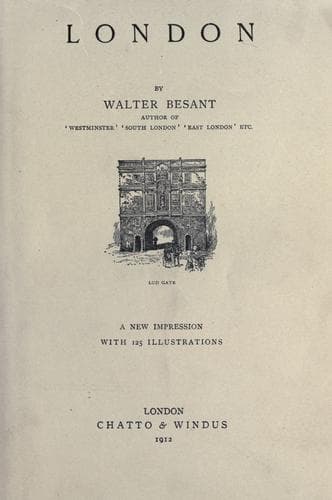
London (England) -- History; London (England) -- Social life and customs
The education of girls was never so thorough as at this time. Perhaps
Lucy Hutchinson and Lady Jane Grey--well-known cases--ought not to be
taken as average examples. The former, for instance, could read at four,
and at seven was under eight tutors, who taught her languages, music,
dancing, writing, and needle-work. She also became a proficient in the
art of preparing simples and medicines. Of her husband she says that he
was a masterly player on the viol; that he was a good marksman with gun
and bow; and that he was a collector of paintings and engravings.
Perhaps there was never a time when body and mind were equally trained
and developed as they were in the sixteenth century. Think with what
contempt Sidney and Raleigh would regard an age like the present, when
the young men are trained to foot-ball, running, and cricket, but, for
the most part, cannot ride, cannot shoot, cannot fence, cannot box,
cannot wrestle, cannot sing, cannot play any instrument, cannot dance,
and cannot make verses!
[Illustration: NEWGATE]
In the matter of rogues, vagabonds, and common cheats, the age of
Elizabeth shows no falling off, but quite the reverse. We have little
precise information on English _ribauderie_ before this time, but now,
thanks to John Awdely, Thomas Harman, Parson Hybesdrine, Thomas Dekker,
Robert Greene, and others, we learn the whole art and mystery of
coney-catching as practised under the Tudor dynasty. The rogues had
their own language. No doubt they always had their language, as they
have it now; and it varied from year to year as it varies now, but the
groundwork remained the same, and, indeed, remains the same to this day.
The rogues and thieves, the beggars and the impostors, are still with
us. They are still accompanied by their autem morts, their walking
morts, their Kynchen morts, their doxies, and their dolls, only some of
those cheats are changed with the changes of the time. Under Queen
Gloriana they abound in every town and in every street, they tramp along
all the roads, they haunt the farm-houses, they rob the market-women and
the old men. They have their ranks and their precedency. The Upright man
is a captain among them; the Curtall has authority over them; the
Patriarch Co-marries them until death do them part--that is to say,
until they pass a carcass of any creature, when, if they choose, they
shake hands and go separate ways. They are well known by profession and
name at every fair throughout the country. They are Great John Gray and
Little John Gray; John Stradling with the shaking head; Lawrence with
the great leg; Henry Smyth, who drawls when he speaks; that fine old
gentleman, Richard Horwood, who is eighty years of age and can still
bite a sixpenny nail asunder with his teeth, and a notable toper still;
Will Pellet, who carries the Kynchen mort at his back; John Browne, the
stammerer; and the rest of them. They are all known; their backs and
shoulders are scored with the nine-tailed cat; not a headborough or a
Public-domain text, read in full here on John Shaqi.
Reviews
Reviews
No reviews yet
Be the first to share your thoughts on this work.
Elsewhere in the archive
Join the Discussion
Join the discussion
Sign in to leave a comment or review.
Sign InorCreate an account