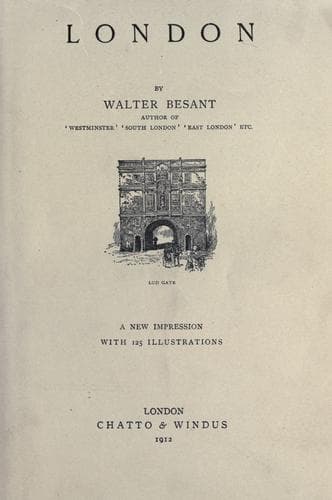
London (England) -- History; London (England) -- Social life and customs
Another royal residence was the house called the Erber. This house
also has a long history. It is said to have been first built by the
Knight Pont de l'Arche, founder of the Priory of St. Mary Overies.
Edward III. gave it to Geoffrey le Scrope. It passed from him to John,
Lord Neville, of Raby, and so to his son Ralph Neville, Earl of
Westmoreland, the stanch supporter of Henry IV. From him the Erber
passed into the hands of another branch of the Nevilles, the Earls of
Salisbury and Warwick. The King-maker resided here, with a following so
numerous that six oxen were daily consumed for breakfast alone, and any
person who was allowed within the gates could take away as much meat,
sodden and roast, as he could carry upon a long dagger. After his death,
George, Duke of Clarence--"false, fleeting, perjured Clarence"--obtained
a grant of the house, in right of his wife, Isabel, daughter of Warwick.
Richard, Duke of Gloucester, succeeded, and called it the King's Palace
during his brief reign. Edward, son of the Duke of Clarence, then
obtained it. In the year 1584 the place, which seems to have fallen into
decay, was rebuilt by Sir Thomas Pulsdon, Lord Mayor. Its last
illustrious occupant, according to Stow, was Sir Francis Drake.
[Illustration: VIEW OF COLD HARBOR IN THAMES STREET, ABOUT 1600]
We are fortunate in having left one house at least, or a fragment of
one, out of the many London palaces. The Fire of 1666 spared Crosby
Place, and though most of the old mansion has been pulled down, there
yet remains the Hall, the so-called Throne Room, and the so-called
Council Room. The mansion formerly covered the greater part of what is
now called Crosby Square. It was built by a simple citizen, a grocer and
Lord Mayor, Sir John Crosby, in the fifteenth century; a man of great
wealth and great position; a merchant, diplomatist, and ambassador. He
rode north to welcome Edward IV. when he landed at Ravenspur; he was
sent by the King on a mission to the Duke of Burgundy and to the Duke of
Brittany. Shakespeare makes Richard of Gloucester living in this house
as early as 1471, four years before the death of Sir John Crosby, a
thing not likely. But he was living here at the death of Edward IV., and
here he held his _levées_ before his usurpation of the crown. In this
hall, where now the City clerks snatch a hasty dinner, sat the last and
worst of the Plantagenets, thinking of the two boys who stood between
him and the crown. Here he received the news of their murder. Here he
feasted with his friends. The place is charged with the memory of
Richard Plantagenet. Early in the next century another Lord Mayor
obtained it, and lent it to the ambassador of the Emperor Maximilian. It
passed next into the hands of a third citizen, also Lord Mayor, and was
bought in 1516 by Sir Thomas More, who lived here for seven years, and
wrote in this house his _Utopia_ and his _Life of Richard the Third_.
His friend, Antonio Bonvici, a merchant of Lucca, next lived in the
Public-domain text, read in full here on John Shaqi.
Reviews
Reviews
No reviews yet
Be the first to share your thoughts on this work.
Elsewhere in the archive
Join the Discussion
Join the discussion
Sign in to leave a comment or review.
Sign InorCreate an account