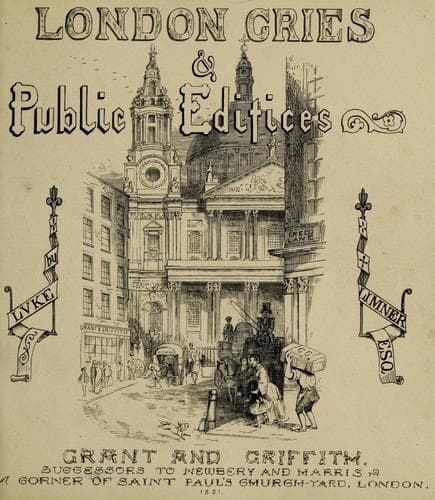
Architecture -- England -- London; Cries -- England -- London; London (England) -- Buildings, structures, etc.
[Illustration: THE EAST-INDIA HOUSE.
RHUBARB.]
[Illustration: THE BANK OF ENGLAND.
MATCHES.]
MATCHES!--BUY A BOX OF MATCHES OF A POOR GIRL!
Of all the poor itinerants of London the Match-sellers are the poorest,
and subsist as much by donations as by the sale of their wares. The old
match, a splinter of wood, with ends dipped in brimstone, is fast
disappearing before the modern lucifer or congreve. The poor creature
here represented is appealing to a lady and gentleman, (whose shadows
are seen in the picture,) on their way to the
BANK OF ENGLAND.
This great national establishment was erected in 1788 by Sir John Soane:
it covers about eight acres of ground, and consists of nine open courts,
almost all the rooms being on the ground-floor, lighted from above,
beneath which are very extensive cellars, used for the deposit of
bullion. This building is raised on the course of the ancient stream of
Wall-Brook. In the Pay-Hall, where the notes are issued and exchanged,
is a marble statue of William III., founder of the Bank, by Cheere. The
Court-Room windows overlook a piece of ground, laid out as a garden:
this was formerly the churchyard of St. Christopher’s; nearly the whole
of this parish is within the walls of the Bank, the church having been
removed in 1780, after the riots. The Bank of England is isolated from
all other buildings, and fire-proof.
ORANGES!--BUY ORANGES AND LEMONS!
Here is a poor Irish boy endeavouring to dispose of his oranges to some
passengers outside an omnibus, in Cornhill, near the
ROYAL EXCHANGE.
The merchants used, in olden times, to meet in Lombard Street, until Sir
Thomas Gresham built the first edifice here, in 1567, from the designs
of Henrick, a Fleming, who, it is said, made constant journeys from
London to Flanders, to obtain materials and workmen. All the stone,
slate, iron, wainscot, and glass, came from Antwerp; so that the first
Exchange might be considered a Dutch building. This pile was burnt down
at the Fire of London, in 1666, and a second Exchange was built on the
old site, by Gernan, the first stone of which was laid by Charles II.,
and was completed in 1669, at an expense of £59,000, and was again
destroyed by fire in 1838. The present edifice occupies the same spot,
of which Prince Albert laid the first stone; and it was opened, with
great display, by her Majesty, Queen Victoria, in October, 1844, during
the mayoralty of Sir W. Magnay. It is from a design by William Tite; the
pediment, seen in the drawing, is by R. Westmacott, Jun.
[Illustration: THE ROYAL EXCHANGE.
ORANGES, SWEET ST:MICHAEL ORANGES.]
[Illustration: THE MANSION HOUSE.
BUY A CAGE FOR YOUR FINE SINGING BIRD.]
BUY A CAGE FOR YOUR FINE SINGING-BIRD!
These little prisons are principally manufactured and sold by
foreigners, who have them of all sizes and shapes (to suit the nature
and habits of the little captive melodists).
THE MANSION-HOUSE
Public-domain text, read in full here on John Shaqi.
Reviews
Reviews
No reviews yet
Be the first to share your thoughts on this work.
Join the Discussion
Join the discussion
Sign in to leave a comment or review.
Sign InorCreate an account