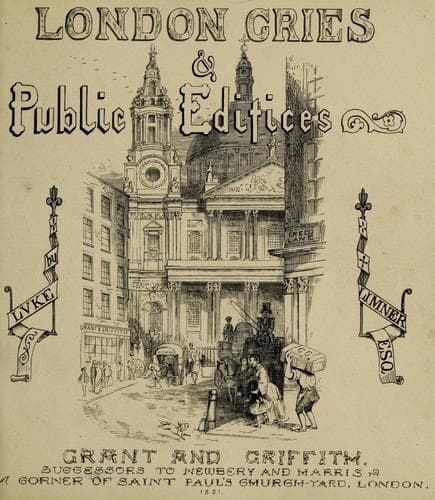
Architecture -- England -- London; Cries -- England -- London; London (England) -- Buildings, structures, etc.
This church was one of fifty, erected by act of Parliament in 1724. John
James was the architect. The first stone was laid by General Stewart,
with the following ceremony:--Having made a libation of wine, he
pronounced these words: “The Lord God of heaven preserve the church of
St. George!” It is dedicated to St. George the Martyr, in honour of
George I. The subject of the altar-piece is the Last Supper, attributed
to Sir James Thornhill. This church is remarkable for the number of
fashionable marriages celebrated here.
BUY A BOX!--BUY A BAND-BOX!
These useful articles are mostly the manufacture of the persons who
carry them about for sale: they are of all shapes and sizes--cap-boxes,
bonnet-boxes, clothes-boxes, &c.
OLD CLOTHES!
“_Clo! Clo!!_” This is the abbreviated cry of the old clothesman, when
going his rounds. The trade is mostly conducted by Jews, who take the
morning purchases to Rosemary Lane, (commonly called Rag Fair,) near
Tower Hill, where they dispose of them to dealers, who patch, mend, and
sell again to the public. Our Jew, judging from his beard and band round
his waist, is some dignitary of the synagogue; he has just made a
purchase of an old court suit at
ST. JAMES’S PALACE.
It is a plain brick building, and was erected by Henry VIII. in 1551.
Queen Anne was the first to hold her court here, since which time it has
been uniformly used for that purpose. Here is the Chapel Royal, in which
our present Queen was married to Prince Albert: it is used only for
purposes of state. King Charles I. passed the last eleven days of his
life here, during his trial. A great portion of the south-eastern corner
was destroyed by fire, in 1809.
[Illustration: SAINT JAMES’ PALACE.
OLD CLOTHES.
BUY A BOX, A BAND BOX.]
[Illustration: WESTMINSTER ABBEY.
AND TOWER OF SAINT MARGARET’S CHURCH.
MILK BELOW.]
MILK BELOW!
Of dealers in milk there are two classes,--the one keeping cows, the
other purchasing from large dairymen in the outskirts, and retailing it
on their own account. Their customers mostly live in neighbouring
streets, which are called “milk-walks,” and are often disposed of as
other trades. It is stated that fifteen thousand cows are necessary to
supply London with milk, and it has been calculated that it is usually
adulterated one-third. The milk-carriers of London are mostly Welsh
girls, and did, until of late, wear the national hat. Our sketch
exhibits one of them carrying home the produce of her master’s cows from
St. James’s Park, while a man drives a cow and calf from the pasture
there; but this is a picture of the past. The park no longer affords
pasture for cattle; population has driven them farther away. The
background remains the same.
WESTMINSTER ABBEY.
Public-domain text, read in full here on John Shaqi.
Reviews
Reviews
No reviews yet
Be the first to share your thoughts on this work.
Join the Discussion
Join the discussion
Sign in to leave a comment or review.
Sign InorCreate an account