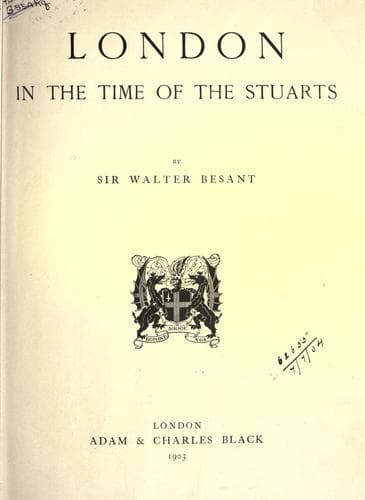
London (England) -- History -- 17th century; London (England) -- Social life and customs -- 17th century
There were two of Charles’s friends, and only two, for whom the City
afterwards entertained a hatred equal to that they felt for Buckingham.
But at that moment there was no one whose death was so ardently
desired. When the news was brought to London, grave citizens drank the
health of Felton. When the murderer was brought to London, the crowd
followed praying that the Lord would comfort him. Such was the mind
of the City towards the man whom Eliot had impeached; they received
the news of his murder with savage exultation. Then Charles made Laud
Bishop of London—the third of the three men whose death a few years
later the City welcomed with shouts of joy. It was not enough to
trample on the liberties of the people, he must now proceed to deprive
them of their religion. The memorable sitting in the House when the
Speaker was held in his chair while the Commons passed resolution after
resolution against innovations in religion and the illegal levy of
taxes, belongs to national history. It was with passionate excitement,
hardly restrained from tumult, that the news of this sitting and these
resolutions was received in the City. There were as yet no newspapers
to furnish day by day a report of the proceedings in the House, but
the tidings of each protest of the Commons and each arbitrary measure
of the King flew through the streets of the City as quickly as if by
means of the daily paper, so that every house was filled with the angry
murmurs of the citizens, and men in the streets and on ’Change looked
at each other and asked what would happen next.
Yet no word of armed resistance. The old time when one King could be
put down and another set up in his place was forgotten. Rebellion was
not yet even thought of. The Parliament was dissolved.
Laud, free to do what he pleased, proceeded whither his pleasure
led him. What he did is national history. The people of London, of
whom nine-tenths were Puritans (see p. 137), or, at least, strong
Protestants, saw with rage the severance of the ties connecting the
Church of England with the foreign Protestant churches; they saw the
forcible introduction of rites and ceremonies offensive to Puritan
feeling; the expulsion of Puritan clergy; the suppression of Puritan
lectures; the prohibition of the Geneva Bible, loved by all the people;
the desecration, as they thought, of their so-called Sabbath; the
restoration of ritualism; the return, as they believed, to Rome.
There seemed no hope of redress. The High Church party were in power;
the return to Rome seemed certain.
Public-domain text, read in full here on John Shaqi.
Reviews
Reviews
No reviews yet
Be the first to share your thoughts on this work.
Join the Discussion
Join the discussion
Sign in to leave a comment or review.
Sign InorCreate an account