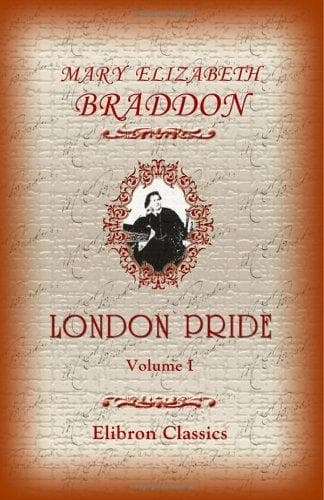
London Pride, Or, When the World Was YoungerBraddon, M. E. (Mary Elizabeth)
History
London Pride, Or, When the World Was Younger
Braddon, M. E. (Mary Elizabeth)
Great Britain -- History -- Charles II, 1660-1685 -- Fiction; London (England) -- Fiction
“Yes, to reverence, to over much reverence, perhaps. She might have
given a freer, fonder love to a more amiable man. I have some strain of
my unhappy kinsman’s temper, perhaps—the disposition that keeps a wife
at a distance. He managed to make three wives afraid of him; and it was
darkly rumoured that he killed one.”
“Strafford—a murderer! No, no.”
“Not by intent. An accident—only an accident. They who most hated him
pretended that he pushed her from him somewhat roughly when she was
least able to bear roughness, and that the after consequences of the
blow were fatal. He was one of the doomed always, you see. He knew that
himself, and told his bosom friend that he was not long-lived. The
brand of misfortune was upon him even at the height of his power. You
may read his destiny in his face.”
They walked on in silence for some time, Angela depressed and unhappy.
It seemed as if Fareham had lifted a mask and shown her his real
countenance, with all the lines that tell a life history. She had
suspected that he was not happy; that the joyous existence amidst
fairest surroundings which seemed so exquisite to her was dull and
vapid for him. She could but think that he was like her father, and
that action and danger were necessary to him, and that it was only this
rustic tranquillity that weighed upon his spirits.
“Do not for a moment believe that I would speak slightingly of your
sister,” Fareham resumed, after that silent interval. “It were indeed
an ill thing in me—most of all to disparage her in your hearing. She is
lovely, accomplished, learned even, after the fashion of the Rue St.
Thomas du Louvre. She used to shine among the brightest at the
Scudèrys’ Saturday parties, which were the most wearisome assemblies I
ever ran away from. The match was made for us by others, and I was her
betrothed husband before I saw her. Yet I loved her at first sight. Who
could help loving a face as fair as morning over the eastward hills, a
voice as sweet as the nightingales in the Tuileries garden? She was so
young—a child almost; so gentle and confiding. And to see her now with
Papillon is to question which is the younger, mother or daughter. Love
her? Why, of course I love her. I loved her then. I love her now. Her
beauty has but ripened with the passing years; and she has walked the
furnace of fine company in two cities, and has never been seared by
fire. Love her! Could a man help loving beauty, and frankness, and a
natural innocence which cannot be spoiled even by the knowledge of
things evil, even by daily contact with sin in high places?”
Again there was a silence, and then, in a deeper tone, after a long
sigh, Fareham said—
“I love and honour my wife; I adore my children; yet I am alone,
Angela, and I shall be alone till death.”
“I don’t understand.”
Public-domain text, read in full here on John Shaqi.
Reviews
Reviews
No reviews yet
Be the first to share your thoughts on this work.
Elsewhere in the archive
Join the Discussion
Join the discussion
Sign in to leave a comment or review.
Sign InorCreate an account