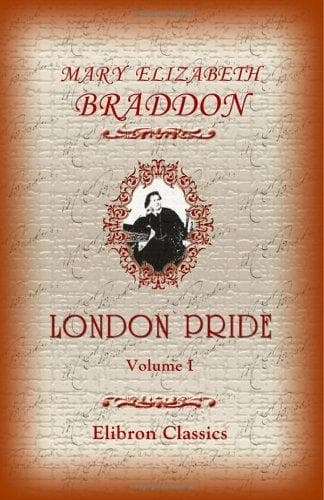
London Pride, Or, When the World Was YoungerBraddon, M. E. (Mary Elizabeth)
History
London Pride, Or, When the World Was Younger
Braddon, M. E. (Mary Elizabeth)
Great Britain -- History -- Charles II, 1660-1685 -- Fiction; London (England) -- Fiction
“Oh yes, you do; you understand as well as I who suffer. My wife and I
love each other dearly. If she have a fit of the vapours, or an aching
tooth, I am wretched. But we have never been companions. The things
that she loves are charmless for me. She is enchanted with people from
whom I run away. Is it companionship, do you think, for me to look on
while she walks a coranto or tosses shuttlecocks with De Malfort?
Roxalana is as much my companion when I admire her on the stage from my
seat in the pit. There are times when my wife seems no nearer to me
than a beautiful picture. If I sit in a corner, and listen to her
pretty babble about the last fan she bought at the Middle Exchange, or
the last witless comedy she saw at the King’s Theatre, is that
companionship, think you? I may be charmed to-day—as I was charmed ten
years ago—with the silvery sweetness of her voice, with the graceful
turn of her head, the white roundness of her throat. At least I am
constant. There is no change in her or in me. We are just as near and
just as far apart as when the priest joined our hands at St. Eustache.
And it must be so to the end, I suppose; and I think the fault is in
me. I am out of joint with the world I live in. I cannot set myself in
tune with their new music. I look back, and remember, and regret; yet
hardly know why I remember or what I regret.”
Again a silence, briefer than the last, and he went on:—
“Do you think it strange that I talk so freely—to you—who are scarce
more than a child, less learned than Henriette in worldly knowledge? It
is a comfort sometimes to talk of one’s self; of what one has missed as
well as of what one has. And you have such an air of being wise beyond
your years; wise in all thoughts that are not of the world—thoughts of
things of which there is no truck at the Exchanges; which no one buys
or sells at Abingdon fair. And you are so near allied to me—a sister! I
never had a sister of my own blood, Angela. I was an only child.
Solitude was my portion. I lived alone with my tutor and
_gouvernante_—a poor relation of my mother’s—alone in a house that was
mostly deserted, for Lord and Lady Fareham were in London with the
King, till the troubles brought the Court to Christchurch, and them to
Chilton. I have had few in whom to confide. And you—remember what you
have been to me, and do not wonder if I trust you more than others.
Thou didst go down to the very grave with me, didst pluck me out of the
pit. Corruption could not touch a creature so lovely and so innocent
Thou didst walk unharmed through the charnel-house. Remembering this,
as I ever must remember, can you wonder that you are nearer to me than
all the rest of the world?”
Public-domain text, read in full here on John Shaqi.
Reviews
Reviews
No reviews yet
Be the first to share your thoughts on this work.
Elsewhere in the archive
Join the Discussion
Join the discussion
Sign in to leave a comment or review.
Sign InorCreate an account