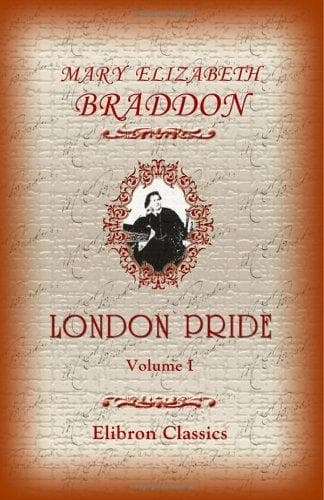
London Pride, Or, When the World Was YoungerBraddon, M. E. (Mary Elizabeth)
History
London Pride, Or, When the World Was Younger
Braddon, M. E. (Mary Elizabeth)
Great Britain -- History -- Charles II, 1660-1685 -- Fiction; London (England) -- Fiction
“And I am as good as a picture—sometimes, madam,” chirped Papillon.
“Mother says I am _douce comme un image._”
“When thou hast been silent or still for five minutes,” said Angela,
“and that is but seldom.”
A loud hand-bell summoned the butler, and an Arcadian meal was speedily
set out on a table in the hall, where a great fire of logs burnt as
merrily as if it had been designed to enliven a Christmas-keeping
household. Indeed there was nothing miserly or sparing about the
housekeeping at the Grange, which harmonised with the sombre richness
of Lady Warner’s grey brocade gown, from the old-fashioned silk
mercer’s at the sign of the Flower-de-luce, in Cheapside. There was
liberality without waste, and a certain quiet refinement in every
detail, which reminded Angela of the convent parlour and her aunt’s
room—and contrasted curiously with the elegant disorder of her sister’s
surroundings.
Papillon clapped her hands at sight of the large plum cake, the jug of
milk, and bowl of blackberry conserve.
“I was so hungry,” she said, apologetically, after Denzil had supplied
her with generous slices of cake, and large spoonfuls of jam. “I did
not know that Nonconformists had such nice things to eat.”
“Did you think we all lay in gaol to suffer cold and hunger for the
faith that is in us, like that poor preacher at Bedford?” asked Lady
Warner, bitterly. “It will come to that some day, perhaps, under the
new Act.”
“Will you show Mistress Kirkland your house, mother, and your dairy?”
Denzil asked hurriedly. “I know she would like to see one of the
neatest dairies in Oxfordshire.”
No request could be more acceptable to Lady Warner, who was a
housekeeper first and a controversialist afterwards. Inclined as she
was to rail against the Church of Rome—partly because she had made up
her mind upon hearsay, chiefly Miltonian, that Roman Catholicism was
only another name for image-worship and martyr-burning, and partly on
account of the favour that had been shown to Papists, as compared with
the cruel treatment of Nonconformists—still there was a charm in
Angela’s gentle beauty against which the daughterless matron could not
steel her heart. She melted in the space of a quarter of an hour, while
Denzil was encouraging Henriette to over-eat herself, and trying to
persuade Angela to taste this or that dainty, or reproaching her for
taking so little; and by the time the child had finished her copious
meal, Lady Warner was telling herself how dearly she might have loved
this girl for a daughter-in-law, were it not for that fatal objection
of a corrupt and pernicious creed.
Public-domain text, read in full here on John Shaqi.
Reviews
Reviews
No reviews yet
Be the first to share your thoughts on this work.
Elsewhere in the archive
Join the Discussion
Join the discussion
Sign in to leave a comment or review.
Sign InorCreate an account