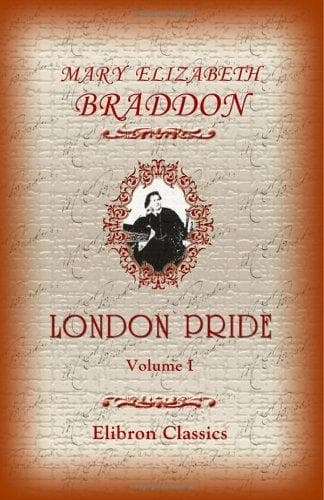
London Pride, Or, When the World Was YoungerBraddon, M. E. (Mary Elizabeth)
History
London Pride, Or, When the World Was Younger
Braddon, M. E. (Mary Elizabeth)
Great Britain -- History -- Charles II, 1660-1685 -- Fiction; London (England) -- Fiction
Angela read of the siege of Dunkirk, where Fareham had fought; of the
tempestuous weather; the camp in the midst of salt marshes and
quicksands, and all the sufferings and perils of life in the trenches.
He had been in more than one of those battles which mademoiselle’s
conscientious pen depicted with such graphic power, the _Gazette_ at
her elbow as she wrote. The names of battles, sieges, Generals, had
been on his lips in his delirious ravings. He had talked of the taking
of Charenton, the key to Paris, a stronghold dominating Seine and
Marne; of Clanleu, the brave defender of the fortress; of Châtillon,
who led the charge—both killed there—Châtillon, the friend of Condé,
who wept bitterest tears for a loss that poisoned victory. Read by
these lights, the “Grand Cyrus” was a book to be pored over, a book to
bend over in the grey winter dusk, reading by the broad blaze of the
logs that flamed and crackled on wrought-iron standards. Just as
merrily the blaze had spread its ruddy light over the room when it was
a monkish refectory, and when the droning of a youthful brother reading
aloud to the fraternity as they ate their supper was the only sound,
except the clattering of knives and grinding of jaws.
Now the room was her ladyship’s drawing-room, bright with Gobelins
tapestry, dazzling with Venetian mirrors, gaudy with gold and colour,
the black oak floor enlivened by many-hued carpets from our new colony
of Tangiers. Fareham told his wife that her Moorish carpets had cost
the country fifty times the price she had paid for them, and were
associated with an irrevocable evil in the existence of a childless
Queen; but that piece of malice, Hyacinth told him, had no foundation
but his hatred of the Duke, who had always been perfectly civil to him.
“Of two profligate brothers I prefer the bolder sinner,” said Fareham.
“Bigotry and debauchery are an ill mixture.”
“I doubt if his Majesty frets for the want of an heir,” remarked De
Malfort. “He is not a family man.”
“He is not a one family man, Count,” answered Fareham.
Fareham and De Malfort were both away on this January evening. Papillon
was taking a dancing lesson from a wizened old Frenchman, who brought
himself and his fiddle from Oxford twice a week for the damsel’s
instruction. Mrs. Priscilla, nurse and _gouvernante_, attended these
lessons, at which the Honourable Henrietta Maria Revel gave herself
prodigious airs, and was indeed so rude to the poor old professor that
her aunt had declined to assist at any more performances.
“Has his lordship gone to Oxford?” Angela asked, after a silence broken
only by her sister’s yawns.
“I doubt he is anywhere rather than in such good company,” Hyacinth
answered, carelessly. “He hates the King, and would like to preach at
him, as John Knox did at his great-grandmother. Fareham is riding, or
roving with his dogs, I dare say. He has a gloomy taste for solitude.”
Public-domain text, read in full here on John Shaqi.
Reviews
Reviews
No reviews yet
Be the first to share your thoughts on this work.
Elsewhere in the archive
Join the Discussion
Join the discussion
Sign in to leave a comment or review.
Sign InorCreate an account