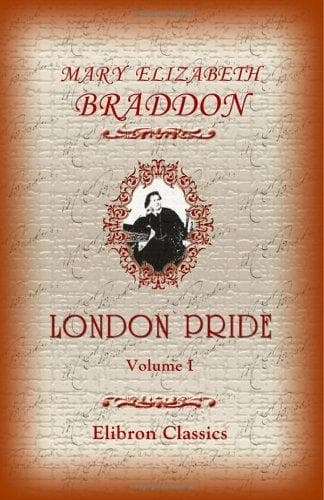
London Pride, Or, When the World Was YoungerBraddon, M. E. (Mary Elizabeth)
History
London Pride, Or, When the World Was Younger
Braddon, M. E. (Mary Elizabeth)
Great Britain -- History -- Charles II, 1660-1685 -- Fiction; London (England) -- Fiction
He was one of those modest lovers who rarely bring a blush to the cheek
of the beloved object, but are so poor-spirited as to do most of the
blushing themselves.
A week later Lady Fareham could do nothing but praise that severe
weather which she had pronounced odious, for her husband, coming in
from Oxford after a ride along the road, deep with melting snow,
brought the news of a considerable diminution in the London death-rate;
and the more startling news that his Majesty had removed to Whitehall
for the quicker despatch of business with the Duke of Albemarle, albeit
the bills of mortality recorded fifteen hundred deaths from the
pestilence in the previous week, and although not a carriage appeared
in the deserted streets of the metropolis except those in his Majesty’s
train.
“How brave, how admirable!” cried Hyacinth, clapping her hands in the
exuberance of her joy. “Then we can go to London to-morrow, if horses
and coaches can be made ready. Give your orders at once, Fareham, I
beseech you. The thaw has set in. There will be no snow to stop us.”
“There will be floods which may make fords impassable.”
“We can avoid every ford—there is always a _détour_ by the lanes.”
“Have you any idea what the lanes will be like after two feet deep of
snow? Be sure, my love, you are happier twanging your lute by this
fireside than you would be stuck in a quagmire, perishing with cold in
a windy coach.”
“I will risk the quagmires and the windy coach. Oh, my lord, if you
ever loved me let us set out to-morrow. I languish for Fareham House—my
basset-table, my friends, my watermen to waft me to and fro between
Blackfriars and Westminster, the mercers in St. Paul’s Churchyard, the
Middle Exchange. I have not bought myself anything pretty since
Christmas. Let us go to-morrow.”
“And risk spoiling the prettiest thing you own—your face—by a
plague-spot.”
“The King is there—the plague is ended.”
“Do you think he is a God, that the pestilence will flee at his
coming?”
“I think his courage is godlike. To be the first to return to that
abandoned city.”
“What of Monk and the Archbishop, who never left it?”
“A rough old soldier! A Churchman! Such lives were meant to face
danger. But his Majesty! A man for whom existence should be one long
holiday?”
“He has done his best to make it so; but the pestilence has shown him
that there are grim realities in life. Don’t fret, dearest. We will go
to town as soon as it is prudent to make the move. Kings must brave
great hazards; and there is no reason that little people like us should
risk our lives because the necessities of State compel his Majesty to
imperil his.”
“We shall be laughed at if we do not hasten after him.”
Public-domain text, read in full here on John Shaqi.
Reviews
Reviews
No reviews yet
Be the first to share your thoughts on this work.
Elsewhere in the archive
Join the Discussion
Join the discussion
Sign in to leave a comment or review.
Sign InorCreate an account