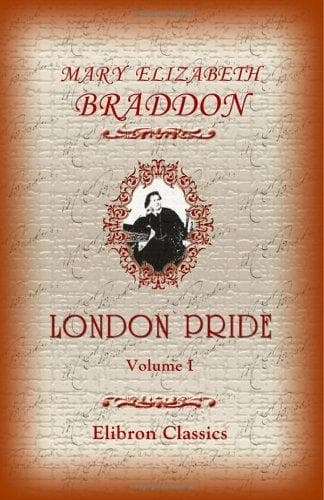
London Pride, Or, When the World Was YoungerBraddon, M. E. (Mary Elizabeth)
History
London Pride, Or, When the World Was Younger
Braddon, M. E. (Mary Elizabeth)
Great Britain -- History -- Charles II, 1660-1685 -- Fiction; London (England) -- Fiction
She laughed at his rude speeches, just as she laughed at his
flatteries—as if there were safety in that atmosphere of idle mirth.
Angela heard and wondered, wondering most perhaps what occupied and
interested Lord Fareham in those white winter days, when he lived for
the greater part alone in his own rooms, or pacing the long walks from
which the gardeners had cleared the snow. He spent some of his time
indoors, deep in a book. She knew as much as that. He had allowed
Angela to read some of his favourites, though he would not permit any
of the new comedies, which everybody at Court was reading, to enter his
house, much to Lady Fareham’s annoyance.
“I am half a century behind all my friends in intelligence,” she said,
“because of your Puritanism. One tires of your everlasting gloomy
tragedies—your _Broken Hearts_ and _Philasters_. I am all for the
genius of comedy.”
“Then satisfy your inclinations, and read Molière. He is second only to
Shakespeare.”
“I have him by heart already.”
The _Broken Heart_ and _Philaster_ delighted Angela; indeed, she had
read the latter play so often, and with such deep interest, that many
passages in it had engraved themselves on her memory, and recurred to
her sometimes in the silence of wakeful nights.
That character of Bellario touched her as no heroine of the “Grand
Cyrus” had power to move her. How elaborately artificial seemed the
Scudèry’s polished tirades, her refinements and quintessences of the
grand passion, as compared with the fervid simplicity of the
woman-page—a love so humble, so intense, so unselfish!
Sir Denzil came to Chilton nearly every day, and was always graciously
received by her ladyship. His Puritan gravity fell away from him like a
pilgrim’s cloak, in the light air of Hyacinth’s amusements. He seemed
to grow younger; and Henriette’s sharp eyes discovered an improvement
in his dress.
“This is your second new suit since Christmas,” she said, “and I’ll
swear it is made by the King’s tailor. Regardez done, madame! What
exquisite embroidery, silver and gold thread intermixed with little
sparks of garnets sewn in the pattern! It is better than anything of
his lordship’s. I wish I had a father who dressed well. I’m sure mine
must be the shabbiest lord at Whitehall. You have no right to be more
modish than monsieur mon père, Sir Denzil.”
“Hold that insolent tongue, p’tit drôle!” cried the mother. “Sir Denzil
is younger by a dozen years than his lordship, and has his reputation
to make at Court, and with the ladies he will meet there. I hope you
are coming to London, Denzil. You shall have a seat in one of our
coaches as soon as the death-rate diminishes, and this odious weather
breaks up.”
“Your ladyship is all goodness. I shall go where my lode-star leads,”
answered Denzil, looking at Angela, and blushing at the audacity of his
speech.
Public-domain text, read in full here on John Shaqi.
Reviews
Reviews
No reviews yet
Be the first to share your thoughts on this work.
Elsewhere in the archive
Join the Discussion
Join the discussion
Sign in to leave a comment or review.
Sign InorCreate an account