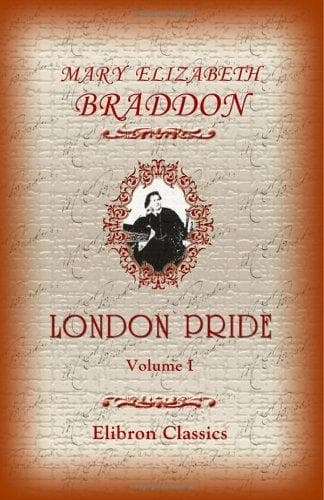
London Pride, Or, When the World Was YoungerBraddon, M. E. (Mary Elizabeth)
History
London Pride, Or, When the World Was Younger
Braddon, M. E. (Mary Elizabeth)
Great Britain -- History -- Charles II, 1660-1685 -- Fiction; London (England) -- Fiction
“An enemy! The man who can so write of women is your worst enemy. The
day will come, perhaps, long after we are dust, when the women in
_Epsom Wells_ will be thought pictures from life. ‘Such an one,’ people
will say, as they stand to read your epitaph, ‘was this Lady Sarah,
whose virtues are recorded here in Latin superlatives. We know her
better in the pages of Shadwell.’”
Lady Sarah paled under her rouge at that image of a tomb, as Fareham’s
falcon eye singled her out in the light-hearted group of which De
Malfort was the central figure, sitting on the marble balustrade, in an
easy impertinent attitude, swinging his legs, and dandling his guitar.
She was less concerned at the thought of what posterity might say of
her morals than at the idea that she must inevitably die.
“Not a word against Shad,” protested Sir Ralph. “I have roared with
laughter at his last play. Never did any one so hit the follies of town
and country. His rural Put is perfection; his London rook is to the
very life.”
“And if the generality of his female characters conduct themselves
badly there is always one heroine of irreproachable morals,” said Lady
Sarah.
“Who talks like a moral dragoon,” said Fareham.
“Oh, dem, we must have the play-houses!” cried Masaroon. “Consider how
dull town is without them. They are the only assemblies that please
quality and riffraff alike. Sure ’tis the nature of wit to bubble into
licentiousness, as champagne foams over the rim of a glass; and, after
all, who listens to the play? Half the time one is talking to some
adventurous miss, who will swallow a compliment from a stranger if he
offer it with a china orange. Or, perhaps, there is quarrelling; and
all our eyes and ears are on the scufflers. One may ogle a pretty
actress on the stage; but who listens to the play, except the cits and
commonalty?”
“And even they are more eyes than ears,” said Lady Sarah, “and are
gazing at the King and Queen, or the Duke and Duchess, when they should
be ‘following an intrigue by Shadwell or Dryden.”
“Pardieu!” exclaimed De Malfort, “there are tragedies and comedies in
the boxes deeper and more human than anything that is acted on the
stage. To watch the Queen, sitting silent and melancholy, while Madame
Barbara lolls across half a dozen people to talk to his Majesty,
dazzling him with her brilliant eyes, bewildering him by her daring
speech. Or, on other nights to see the same lady out of favour, sitting
apart, with an ivory shoulder turned towards Royalty, scowling at the
audience like a thunder-cloud.”
Public-domain text, read in full here on John Shaqi.
Reviews
Reviews
No reviews yet
Be the first to share your thoughts on this work.
Elsewhere in the archive
Join the Discussion
Join the discussion
Sign in to leave a comment or review.
Sign InorCreate an account