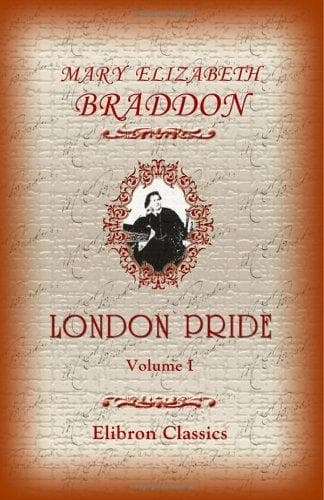
London Pride, Or, When the World Was YoungerBraddon, M. E. (Mary Elizabeth)
History
London Pride, Or, When the World Was Younger
Braddon, M. E. (Mary Elizabeth)
Great Britain -- History -- Charles II, 1660-1685 -- Fiction; London (England) -- Fiction
“Indeed he is not happy. I question and perplex myself to find a reason
for his melancholy. He is rich in money and in powerful friends; has a
wife whom all the world admires; houses which might lodge Royalty.
Perhaps it is because his life has been over prosperous that he sickens
of it, like one who flings away from a banquet table, satiated by
feasting. Life to him may be like the weariness of our English dinners,
where one mountain of food is carried away to make room on the board
for another; and where after people have sat eating and drinking for
over an hour comes a roasted swan, or a peacock, or some other
fantastical dish, which the company praise as a pretty surprise. Often,
in the midst of such a dinner, I recall our sparing meals in the
convent; our soup maigre and snow eggs, our cool salads and black
bread—and regret that simple food, while the reeking joints and
hecatombs of fowl nauseate my senses.
“It was late in the afternoon when we returned to the barge, for Mr.
Pepys had business to transact with our host, and spent an hour with
him in his study, signing papers, and looking at accounts, while
Papillon and I roamed about the garden with his lordship, conversing
upon various subjects, and about Mr. Evelyn, and his opinions and
politics.
“‘The good man has a pretty trivial taste that will keep him amused and
happy till he drops into the grave—but, lord! what insipid trash it all
seems to the heart on fire with passion!’ Fareham said in his impetuous
way, as if he despised Mr. Evelyn for taking pleasure in bagatelles.
“The sun was setting as we passed Greenwich, and I thought of those who
had lived and made history in the old palace—Queen Elizabeth, so great,
so lonely; Shakespeare, whom his lordship honours; Bacon, said to be
one of the wisest men who have lived since the Seven of Greece;
Raleigh, so brave, so adventurous, so unhappy! Surely men and women
must have been made of another stuff a century ago; for what will those
who come after us remember of the wits and beauties of Whitehall,
except that they lived and died?
“Mr. Pepys was somewhat noisy on the evening voyage, and I was very
glad when he left the barge. He paid me ridiculous compliments mixed
with scraps of French and Spanish, and, finding his conversation
distasteful, he insisted upon attempting several songs—not one of which
he was able to finish, and at last began one which for some reason made
his lordship angry, who gave him a cuff on his head that scattered all
the scented powder in his wig; on which, instead of starting up furious
to return the blow, as I feared to see him, Mr. Pepys gave a little
whimpering laugh, muttered something to the effect that his lordship
was vastly nice, and sank down in a corner of the cushioned seat, where
he almost instantly fell asleep.
“Henriette and I were spectators of this scene at some distance, I am
glad to say, for all the length of the barge divided us from the noisy
singer.
Public-domain text, read in full here on John Shaqi.
Reviews
Reviews
No reviews yet
Be the first to share your thoughts on this work.
Elsewhere in the archive
Join the Discussion
Join the discussion
Sign in to leave a comment or review.
Sign InorCreate an account