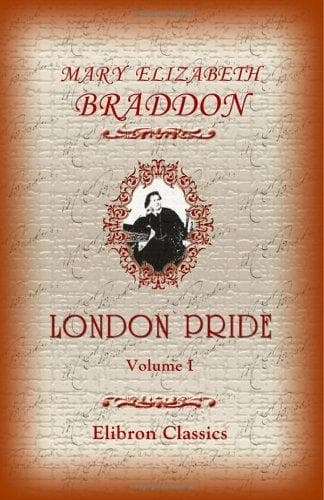
London Pride, Or, When the World Was YoungerBraddon, M. E. (Mary Elizabeth)
History
London Pride, Or, When the World Was Younger
Braddon, M. E. (Mary Elizabeth)
Great Britain -- History -- Charles II, 1660-1685 -- Fiction; London (England) -- Fiction
“The sun went down, and the stars stole out of the deep blue vault, and
trembled between us and those vast fields of heaven. Papillon watched
their reflection in the river, or looked at the houses along the shore,
few and far apart, where a solitary candle showed here and there.
Fareham came and seated himself near us, but talked little. We drew our
cloaks closer, for the air was cold, and Papillon nestled beside me and
dropped asleep. Even the dipping of the oars had a ghostly sound in the
night stillness; and we seemed so melancholy in this silence, and so
far away from one another, that I could but think of Charon’s boat
laden with the souls of the dead.
“Write to me soon, dearest, and as long a letter as I have written to
you.
“À toi de cœur,
“ANGELA.”
CHAPTER XIV.
THE MILLBANK GHOST.
One of the greatest charms of London has ever been the facility of
getting away from it to some adjacent rustic or pseudo-rustic spot; and
in 1666, though many people declared that the city had outgrown all
reason, and was eating up the country, a two-mile journey would carry
the Londoner from bricks and mortar to rusticity, and while the tower
of St Paul’s Cathedral was still within sight he might lie on the grass
on a wild hillside, and hear the skylark warbling in the blue arch
above him, and scent the hawthorn blowing in untrimmed hedge-rows. And
then there were the fashionable resorts—the gardens or the fields which
the town had marked as its own. Beauty and wit had their choice of such
meeting-grounds between Westminster and Barn Elms, where in the remote
solitudes along the river murder might be done in strict accordance
with etiquette, and was too seldom punished by law.
Among the rendezvous of fashion there was one retired spot less widely
known than Fox Hall or the Mulberry Garden, but which possessed a
certain repute, and was affected rather by the exclusives than by the
crowd. It was a dilapidated building of immemorial age, known as the
“haunted Abbey,” being, in fact, the refectory of a Cistercian
monastery, of which all other remains had disappeared long ago. The
Abbey had flourished in the lifetime of Sir Thomas More, and was
mentioned in some of his familiar epistles. The ruined building had
been used as a granary in the time of Charles the First; and it was
only within the last decade that it had been redeemed from that
degraded use, and had been in some measure restored and made habitable
for the occupation of an old couple, who owned the surrounding fields,
and who had a small dairy farm from which they sent fresh milk into
London every morning.
Public-domain text, read in full here on John Shaqi.
Reviews
Reviews
No reviews yet
Be the first to share your thoughts on this work.
Elsewhere in the archive
Join the Discussion
Join the discussion
Sign in to leave a comment or review.
Sign InorCreate an account