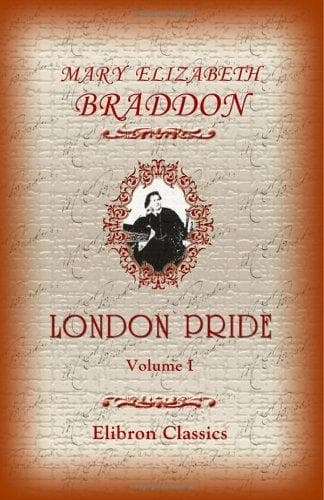
London Pride, Or, When the World Was YoungerBraddon, M. E. (Mary Elizabeth)
History
London Pride, Or, When the World Was Younger
Braddon, M. E. (Mary Elizabeth)
Great Britain -- History -- Charles II, 1660-1685 -- Fiction; London (England) -- Fiction
The barge wore a much more festive aspect under her ladyship’s
management than when used by his lordship for a daylight voyage like
the trip to Deptford. Satin coverlets and tapestry curtains had been
brought from Lady Fareham’s own apartments, to be flung with studied
carelessness over benches and tabourets. Her ladyship’s singing-boys
and musicians were grouped picturesquely under a silken canopy in the
bows, and a row of lanterns hung on chains festooned from stem to
stern, pretty gew-gaws, that had no illuminating power under that
all-potent moon, but which glittered with coloured light like jewels,
and twinkled and trembled in the summer air.
A table in the stern was spread with a light collation, which gave an
excuse for the display of parcel-gilt cups, silver tankards, and
Venetian wine-flasks. A miniature fountain played perfumed waters in
the midst of this splendour; and it amused the ladies to pull off their
long gloves, dip them in the scented water, and flap them in the faces
of their beaux.
The distance was only too short, since Lady Fareham’s friends declared
the voyage was by far the pleasanter part of the entertainment. Denzil,
among others, was of this opinion, for it was his good fortune to have
secured the seat next Angela, and to be able to interest her by his
account of the buildings they passed, whose historical associations
were much better known to him than to most young men of his epoch. He
had sat at the feet of a man who scoffed at Pope and King, and hated
Episcopacy, but who revered all that was noble and excellent in
England’s past.
“Flams, mere flams!” cried Hyacinth, acknowledging the praises bestowed
on her barge; “but if you like clary wine better than skimmed milk you
had best drink a brimmer or two before you leave the barge, since ’tis
odds you’ll get nothing but syllabubs and gingerbread from Lady Sarah.”
“A substantial supper might frighten away the ghost, who doubtless
parted with sensual propensities when she died,” said De Malfort. “How
do we watch for her? In a severe silence, as if we were at church?”
“Aw would keep silence for a week o’ Sawbaths gin Aw was sure o’ seeing
a bogle,” said Lady Euphemia Dubbin, a Scotch marquess’s daughter, who
had married a wealthy cit, and made it the chief endeavour of her life
to ignore her husband and keep him at a distance.
She hated the man only a little less than his plebeian name, which she
had not succeeded in persuading him to change, because, forsooth, there
had been Dubbins in Mark Lane for many generations. All previous
Dubbins had lived over their warehouses and offices; but her ladyship
had brought Thomas Dubbin from Mark Lane to my Lord Bedford’s Piazza in
the Convent Garden, where he endured the tedium of existence in a fine
new house in which he was afraid of his fine new servants, and never
had anything to eat that he liked, his gastronomic taste being for
dishes the very names of which were intolerable to persons of quality.
Public-domain text, read in full here on John Shaqi.
Reviews
Reviews
No reviews yet
Be the first to share your thoughts on this work.
Elsewhere in the archive
Join the Discussion
Join the discussion
Sign in to leave a comment or review.
Sign InorCreate an account