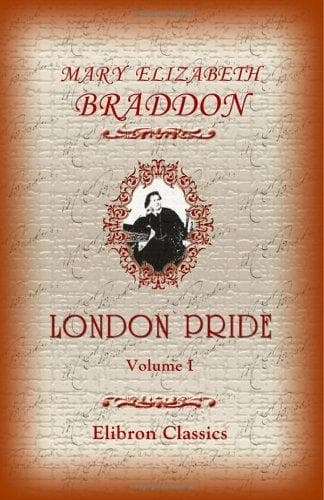
London Pride, Or, When the World Was YoungerBraddon, M. E. (Mary Elizabeth)
History
London Pride, Or, When the World Was Younger
Braddon, M. E. (Mary Elizabeth)
Great Britain -- History -- Charles II, 1660-1685 -- Fiction; London (England) -- Fiction
Every one agreed that the long dry summer menaced some catastrophic
change which should surprise this easy-going age as the plague had done
last year. But oh, how lightly that widespread calamity had touched
those light minds! and, if Providence had designed to warn or to
punish, how vain had been the warning, and how soon forgotten the
penalty that had left the worst offenders unstricken!
There was to be a play at Whitehall that evening, his Majesty and the
Court having returned from Tunbridge Wells, the business of the navy
calling Charles to council with his faithful General—_the_ General _par
excellence_, George Monk, Duke of Albemarle, and his Lord High Admiral
and brother—_par excellence_ the Duke. Even in briefest residence, and
on sternest business intent, with the welfare and honour of the nation
contingent on their consultations, to build or not to build warships of
the first magnitude, the ball of pleasure must be kept rolling. So
Killigrew was to produce a new version of an old comedy, written in the
forties, but now polished up to the modern style of wit. This new-old
play, _The Parson’s Widow_, was said to be all froth and sparkle and
current interest, fresh as the last _London Gazette_, and spiced with
allusions to the late sickness, an admirable subject, and allowing a
wide field for the ridiculous.
Hyacinth was to be present at this Court function; but not a word was
to be said to Angela about the entertainment.
“She would only preach me a sermon upon Fareham’s tastes and wishes,
and urge me to stay away because he abhors a fashionable comedy,” she
told De Malfort, “I shall say I am going to Lady Sarah’s to play
basset. Ange hates cards, and will not desire to go with me. She is
always happy with the children, who adore her.”
“Faute de mieux.”
“You are so ready to jeer! Yes, I know I am a neglectful mother. But
what would you have?”
“I would have you as you are,” he answered, “and only as you are; or
for choice a trifle worse than you are; and so much nearer my own
level.”
“Oh, I know you! It is the wicked women you admire—like Madame Palmer.”
“Always harping upon Barbara. ‘My mother had a maid called Barbara.’
His Majesty has—a lady of the same melodious name. Well, I have a world
of engagements between now and nine o’clock, when the play begins. I
shall be at the door to lift you out of your chair. Cover yourself with
your richest jewels—or at least those you love best—so that you may
blaze like the sun when you cast off the nun’s habit. All the town will
be there to admire you.”
“All the town! Why, there is no one in London!”
“Indeed, you mistake. Travelling is so easy nowadays. People tear to
and fro between Tunbridge and St James’s as often as they once
circulated betwixt London and Chelsea. Were it not for the highwaymen
we should be always on the road.”
Public-domain text, read in full here on John Shaqi.
Reviews
Reviews
No reviews yet
Be the first to share your thoughts on this work.
Elsewhere in the archive
Join the Discussion
Join the discussion
Sign in to leave a comment or review.
Sign InorCreate an account