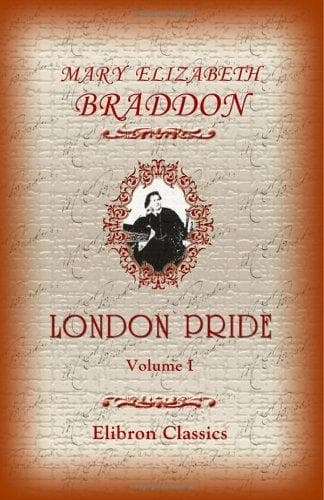
London Pride, Or, When the World Was YoungerBraddon, M. E. (Mary Elizabeth)
History
London Pride, Or, When the World Was Younger
Braddon, M. E. (Mary Elizabeth)
Great Britain -- History -- Charles II, 1660-1685 -- Fiction; London (England) -- Fiction
Had her sister gone to Whitehall to see the new comedy, in direct
disobedience to her husband, instead of to so accustomed an
entertainment as Lady Sarah’s basset-table? And was that the only
mystery between Hyacinth and De Malfort? Or was there something
else—some ghost-party, such as they had planned and talked about openly
till a fortnight ago, and had suddenly dropped altogether, as if the
notion were abandoned and forgotten? It was so unlike Hyacinth to be
secret about anything; and her sister feared, therefore, that there was
some plot of De Malfort’s contriving—De Malfort, whom she regarded with
distrust and even repugnance; for she could recall no sentiment of his
that did not make for evil. Beneath that gossamer veil of airy language
which he flung over vicious theories, the conscienceless, unrelenting
character of the man had been discovered by those clear eyes of the
meditative onlooker. Alas! what a man to be her sister’s closest
friend, claiming privileges by long association, which Hyacinth would
have been the last to grant her dissolute admirers of yesterday, but
which were only the more perilous for those memories of childhood that
justified a so dangerous friendship.
She was startled from these painful reflections by the clatter of
horses’ hoofs on the paved courtyard east of the house, and the jingle
of sword-belt and bit, sounds instantly followed by the ringing of the
bell at the principal door.
Was it her sister coming home so early? No, Lady Fareham had gone out
in her chair. Was it his lordship returning unannounced? He had stated
no time for his return, telling his wife only that, on his business in
Paris being finished, he would come back without delay. Indeed,
Hyacinth had debated the chances of his arrival this very evening with
half a dozen of her particular friends, who knew that she was going to
see Mr. Killigrew’s play.
“Fate cannot be so perverse as to bring him back on the only night when
his return would be troublesome,” she said.
“Fate is always perverse, and a husband is very lucky if there is but
one day out of seven on which his return would be troublesome,”
answered one of her gossips.
Fate had been perverse, for Angela heard her brother-in-law’s deep
strong voice talking in the hall, and presently he came down the marble
steps to the terrace, and came towards her, white with Kentish dust,
and carrying an open letter in his hand. She had risen at the sound of
the bell, and was hurrying to the house as he met her. He came close up
to her, scarcely according her the civility of greeting. Never had she
seen his countenance more gloomy.
“You can tell me truer than those drunken devils below stairs,” he
said. “Where is your sister?”
“At Lady Sarah Tewkesbury’s.”
“So her major-domo swears; but her chairmen, whom I found asleep in the
hall, say they set her down at the palace.”
“At Whitehall?”
Public-domain text, read in full here on John Shaqi.
Reviews
Reviews
No reviews yet
Be the first to share your thoughts on this work.
Elsewhere in the archive
Join the Discussion
Join the discussion
Sign in to leave a comment or review.
Sign InorCreate an account