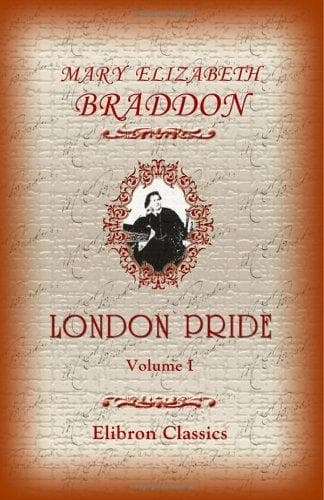
London Pride, Or, When the World Was YoungerBraddon, M. E. (Mary Elizabeth)
History
London Pride, Or, When the World Was Younger
Braddon, M. E. (Mary Elizabeth)
Great Britain -- History -- Charles II, 1660-1685 -- Fiction; London (England) -- Fiction
She dragged him towards the window; he pretending to resist, as Angela
thought, yet letting himself be led as she pleased to lead him. They
had but just crossed the yawning gap between the mullions and vanished
into the night, when Fareham burst into the room with his sword drawn,
and came towards Angela, who stood in shadow, her face half hidden in
her close-fitting hood.
“So, madam, I have found you at last,” he said; “and in time to stop
your journey, though not to save myself the dishonour of a wanton wife!
But it is your paramour I am looking for, not you. Where is that craven
hiding?”
He went back to the inhabited part of the house, and returned after a
hasty examination of the premises, carrying the lamp which had lighted
his search, only to find the same solitary figure in the vast bare
room. Angela had moved nearer the window, and had sunk exhausted upon a
large carved oak chair, which might be a relic of the monkish
occupation. Fareham came to her with the lamp in his hand.
“He has given me a clean pair of heels,” he said; “but I know where to
find him. It is but a pleasure postponed. And now, woman, you had best
return to the house your folly, or your sin, has disgraced. For
to-night, at least, it must needs shelter you. Come!”
The hooded figure rose at his bidding, and he saw the face in the
lamplight.
“You!” he gasped. “You!”
“Yes, Fareham, it is I. Cannot you take a kind view of a foolish
business, and believe there has been only folly and no dishonour in the
purpose that brought me here?”
“You!” he repeated. “You!”
His bearing was that of a man who staggers under a crushing blow, a
stroke so unexpected that he can but wonder and suffer. He set down the
lamp with a shaking hand, then took two or three hurried turns up and
down the room; then stopped abruptly by the lamp, snatched the
anonymous letter from his breast, and read the lines over again.
“‘An intrigue on foot——’ No name. And I took it for granted my wife was
meant. I looked for folly from her; but wisdom, honour, purity, all the
virtues from you. Oh, what was the use of my fortitude, what the motive
of self-conquest here,” striking himself upon the breast, “if you were
unchaste? Angela, you have broken my heart.”
There was a long pause before she answered, and her face was turned
from him to hide her streaming tears. At last she was able to reply
calmly—
“Indeed, Fareham, you do wrong to take this matter so passionately. You
may trust my sister and me. On my honour, you have no cause to be angry
with either of us.”
“And when I gave you this letter to read,” he went on, disregarding her
protestations, “you knew that you were coming here to meet a lover. You
hurried away from me, dissembler as you were, to steal to this lonely
place at midnight, to fling yourself into his arms. Tell me where he is
hiding, that I may kill him; now, while I pant for vengeance. Such rage
as mine cannot wait for idle forms. Now, now, now, is the time to
reckon with your seducer!”
Public-domain text, read in full here on John Shaqi.
Reviews
Reviews
No reviews yet
Be the first to share your thoughts on this work.
Elsewhere in the archive
Join the Discussion
Join the discussion
Sign in to leave a comment or review.
Sign InorCreate an account