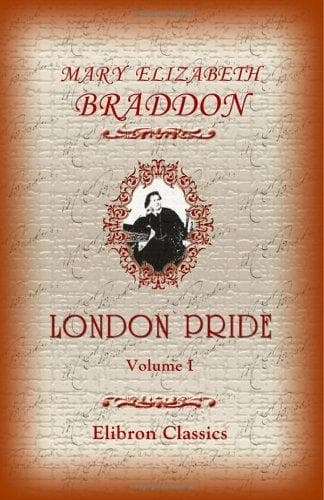
London Pride, Or, When the World Was YoungerBraddon, M. E. (Mary Elizabeth)
History
London Pride, Or, When the World Was Younger
Braddon, M. E. (Mary Elizabeth)
Great Britain -- History -- Charles II, 1660-1685 -- Fiction; London (England) -- Fiction
“Fareham, you cover me with insults!”
He had rushed to the door, still carrying his naked sword; but he
turned back as she spoke, and stood looking at her from head to foot
with a savage scornfulness.
“Insult!” he cried. “You have sunk too low for insult. There are no
words that I know vile enough to stigmatise such disgrace as yours! Do
you know what you have been to me, Angela? A saint—a star; ineffably
pure, ineffably remote; a creature to worship at a distance; for whose
sake it was scarce a sacrifice to repress all that is common to the
base heart of man; from whom a kind word was enough for happiness—so
pure, so far away, so detached from this vile age we live in. God, how
that saintly face has cheated me! Mock saint, mock nun; a creature of
passions like my own but more stealthy; from top to toe an incarnate
lie!”
He flung out of the room, and she heard his footsteps about the house,
and heard doors opened and shut. She waited for no more; but, being
sure by this time that her sister had left the premises, her own desire
was to return to Farebam House as soon as possible, counting upon
finding Hyacinth there; yet with a sick fear that the seducer might
take base advantage of her sister’s terror and confused spirits, and
hustle her off upon the fatal journey he had planned.
The boat lay where she had moored it, at the foot of the wooden stair,
and she was stepping into it when Fareham ran hastily to the bank.
“Your paramour has got clear off,” he said; and then asked curtly, “How
came you by that boat?”
“I brought it from Fareham House.”
“What! you came here alone by water at so late an hour! You heaven-born
adventuress! Other women need education in vice; but to you it comes by
nature.”
He pulled off his doublet as he stepped into the boat; then seated
himself and took the sculls.
“Has your lordship not left a horse waiting for you?” Angela inquired
hesitatingly.
“My lordship’s horse will find his stables before morning with the
groom that has him in charge. I am going to row you home. Love
expectant is bold; but disappointed love may lack courage for a
solitary jaunt after midnight. Come, mistress, let us have no ceremony.
We have done with that for ever—as we have done with friendship. There
are thousands of women in England, all much of a pattern; and you are
one of them. That is the end of our romance.”
He bent to his work, and rowed with a steady stroke, and in a stubborn
silence, which lasted till it was more strangely broken than such angry
silence is apt to be.
The tide was still running up, and it was as much as the single oarsman
could do, in that heavy boat, to hold his own against the stream.
Public-domain text, read in full here on John Shaqi.
Reviews
Reviews
No reviews yet
Be the first to share your thoughts on this work.
Elsewhere in the archive
Join the Discussion
Join the discussion
Sign in to leave a comment or review.
Sign InorCreate an account