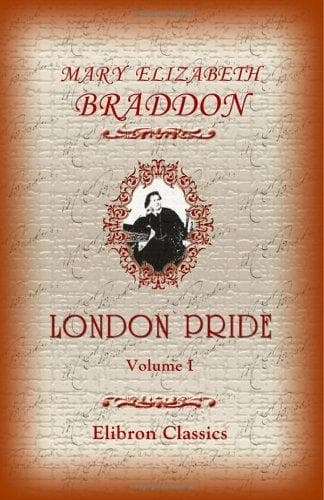
London Pride, Or, When the World Was YoungerBraddon, M. E. (Mary Elizabeth)
History
London Pride, Or, When the World Was Younger
Braddon, M. E. (Mary Elizabeth)
Great Britain -- History -- Charles II, 1660-1685 -- Fiction; London (England) -- Fiction
“No, I was not inquisitive. I was only vastly hipped for want of
knowing what to do with myself. And I ran to bid her ladyship good
morning, for it was close upon one o’clock; but she frowned at me, and
pushed me aside with a ‘Go to your bed, troublesome imp! What business
have you up at this hour?’ ‘As much business as you have riding about
in your coach,’ I had a mind to say, mais je me tenais coy; and made
her ladyship la belle Jennings’ curtsy instead. She sinks lower and
rises straighter than any of the other ladies. I watched her on
mother’s visiting-day. Lord, auntie, how white you are! One might take
you for a ghost!”
Angela put the little prattler aside, more gently, perhaps, than the
mother had done, and passed hurriedly on to Lady Fareham’s room. The
door was still locked, but she would take no denial.
“I must speak with you,” she said.
CHAPTER XVII.
THE MOTIVE—MURDER.
For Lady Fareham and her sister September and October made a blank
interval in the story of life—uneventful as the empty page at the end
of a chapter. They spent those months at Fareham, a house which
Hyacinth detested, a neighbourhood where she had never condescended to
make friends. She condemned the local gentry as a collection of
nobodies, and had never taken the trouble to please the three or four
great families within a twenty-mile drive, because, though they had
rank and consequence, they had not fashion. The _haut gout_ of Paris
and London was wanting to them.
Lord Fareham had insisted upon leaving London on the third of
September, and had, his wife declared, out of pure malignity, taken his
family to Fareham, a place she hated, rather than to Chilton, a place
she loved, at least as much as any civilised mortal could love the
country. Never, Hyacinth protested, had her husband been so sullen and
ferocious.
“He is not like an angry man,” she told Angela, “but like a wounded
lion; and yet, since your goodness took all the blame of my unlucky
escapade upon your shoulders, and he knows nothing of De Malfort’s
insolent attempt to carry me off, I see no reason why he should have
become such a gloomy savage.”
She accepted her sister’s sacrifice with an amiable lightness. How
could it harm Angela to be thought to have run out at midnight for a
frolic rendezvous? The maids of honour had some such adventure half a
dozen times in a season, and were found out, and laughed at, and
laughed again, and wound up their tempestuous careers by marrying great
noblemen.
“If you can but get yourself talked about you may marry as high as you
choose,” Lady Fareham told her sister.
Public-domain text, read in full here on John Shaqi.
Reviews
Reviews
No reviews yet
Be the first to share your thoughts on this work.
Elsewhere in the archive
Join the Discussion
Join the discussion
Sign in to leave a comment or review.
Sign InorCreate an account