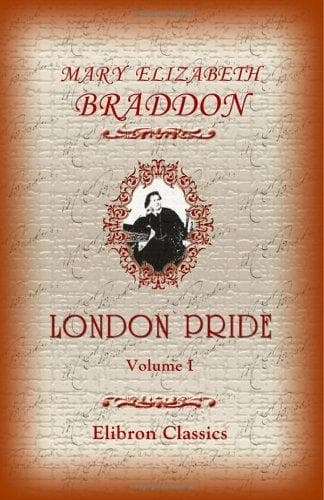
London Pride, Or, When the World Was YoungerBraddon, M. E. (Mary Elizabeth)
History
London Pride, Or, When the World Was Younger
Braddon, M. E. (Mary Elizabeth)
Great Britain -- History -- Charles II, 1660-1685 -- Fiction; London (England) -- Fiction
Early in November they went back to London, and though all Hyacinth’s
fine people protested that the town stank of burnt wood, smoked oil,
and resin, and was altogether odious, they rejoiced not the less to be
back again. Lady Fareham plunged with renewed eagerness into the
whirlpool of pleasure, and tried to drag Angela with her; but it was a
surprise to both, and to one a cause for uneasiness, when his lordship
began to show himself in scenes which he had for the most part avoided
as well as reviled. For some unexplained reason he became now a
frequent attendant at the evening festivities at Whitehall, and without
even the pretence of being interested or amused there.
Fareham’s appearance at Court caused more surprise than pleasure in
that brilliant circle. The statue of the Comandante would scarcely have
seemed a grimmer guest. He was there in the midst of laughter and
delight, with never a smile upon his stern features. He was silent for
the most part, or if badgered into talking by some of his more familiar
acquaintances, would vent his spleen in a tirade that startled them, as
the pleasant chirpings of a poultry-yard are startled by the raid of a
dog. They laughed at his conversation behind his back; but in his
presence, under the angry light of those grey eyes, the gloom of those
bent brows, they were chilled into submission and civility. He had a
dignity which made his Puritanical plainness more patrician than
Rochester’s finery, more impressive than Buckingham’s graceful
splendour. The force and vigour of his countenance were more striking
than Sedley’s beauty. The eyes of strangers singled him out in that gay
throng, and people wanted to know who he was and what he had done for
fame.
A soldier, yes, cela saute aux yeux. He could be nothing else than a
soldier. A cavalier of the old school. Albeit younger by half a
lifetime than Southampton and Clarendon, and the other ghosts of the
troubles.
Charles treated him with chill civility.
“Why does the man come here without his wife?” he asked De Malfort.
“There is a sister, too, fresher and fairer than her ladyship. Why are
we to have the shadow without the sun? Yet it is as well, perhaps, they
keep away; for I have heard of a visit which was not returned—a
condescension from a woman of the highest rank slighted by a trumpery
baron’s wife—and after an offence of that kind she could only have
brought us trouble. Why do women quarrel, Wilmot?”
“Why are there any men in the world, sir? If there were none, women
would live together like lambs in a meadow. It is only about us they
fight. As for Lady Fareham, she is adorable, though no longer young. I
believe she will be thirty on her next birthday.”
Public-domain text, read in full here on John Shaqi.
Reviews
Reviews
No reviews yet
Be the first to share your thoughts on this work.
Elsewhere in the archive
Join the Discussion
Join the discussion
Sign in to leave a comment or review.
Sign InorCreate an account