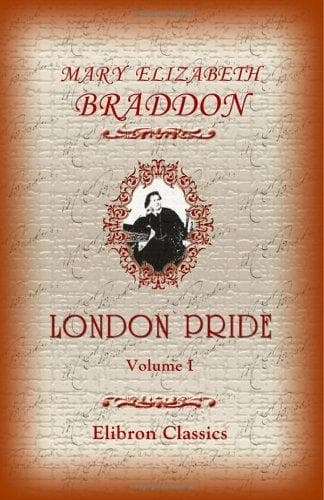
London Pride, Or, When the World Was YoungerBraddon, M. E. (Mary Elizabeth)
History
London Pride, Or, When the World Was Younger
Braddon, M. E. (Mary Elizabeth)
Great Britain -- History -- Charles II, 1660-1685 -- Fiction; London (England) -- Fiction
“The Chancellor is a domestic man; as your Majesty may infer from the
size and splendour of his new house.”
“He is an expensive man, Wilmot I believe he got more by the sale of
Dunkirk than his master did.”
“In that case your Majesty cannot do better than shift all the disgrace
of the transaction on to his shoulders. Dunkirk will be a sure card to
play when Clarendon has to go overboard.”
That incivility of Lady Fareham’s in the matter of an unreturned visit
had rankled deep in the bosom of the King’s imperious mistress. To sin
more boldly than woman ever sinned, and yet to claim all the privileges
and honours due to virtue was but a trifling inconsistency in a mind so
fortified by pride that it scarce knew how to reckon with shame. That
she, in her supremacy of beauty and splendour, a fortune sparkling in
either ear, the price of a landed estate on her neck—that she, Barbara,
Countess of Castlemaine, should have driven in a windowless coach
through dusty lanes, eating dirt, as it were, with her train of court
gallants on horseback at her coach doors, her ladies in a carriage in
the rear, to visit a person of Lady Fareham’s petty quality, a
Buckinghamshire Knight’s daughter married to a Baron of Henry the
Eighth’s creation! And that this amazing condescension—received with a
smiling and curtsying civility—should have been unacknowledged by any
reciprocal courtesy was an affront that could hardly be wiped out with
blood. Indeed, it could never be atoned for. The wound was poisoned,
and would rankle and fester to the end of that proud life.
Yet on Fareham’s appearance at Whitehall Lady Castlemaine distinguished
with a marked civility, and even condescended, smilingly, as if there
were no cause of quarrel, to inquire after his wife.
“Her ladyship is as pretty as ever, though we are all growing old,” she
said. “We exchanged curtsies at Tunbridge Wells the other day. I wonder
how it is we never get further than smiles and curtsies? I should like
to show the dear woman some more substantial civility. She is buried
alive in your stately house by the river, for the want of an
influential friend to show her the world we live in.”
“Indeed, madam, my wife has all the pleasure she desires—her
visiting-day, her friends.”
“And her admirers. Rochester is always hanging about your garden, or
landing from his wherry, when I go by; or, if he himself be not
visible, there are a couple of his watermen on your steps.”
“My Lord Rochester has a precocious wit which amuses my wife and her
sister.”
“And then there is De Malfort—an impertinent, second only to Gramont.
He and Lady Fareham are twin stars. I have seldom seen them apart.”
“Since De Malfort has the honour of being somewhat intimate with your
ladyship, he has doubtless given you full particulars of his friendship
for my wife. I assure you it will bear being talked about. There are no
secrets in it.”
Public-domain text, read in full here on John Shaqi.
Reviews
Reviews
No reviews yet
Be the first to share your thoughts on this work.
Elsewhere in the archive
Join the Discussion
Join the discussion
Sign in to leave a comment or review.
Sign InorCreate an account