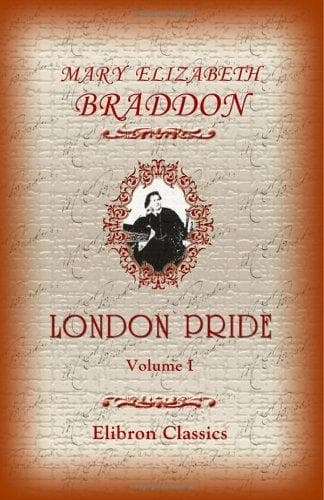
London Pride, Or, When the World Was YoungerBraddon, M. E. (Mary Elizabeth)
History
London Pride, Or, When the World Was Younger
Braddon, M. E. (Mary Elizabeth)
Great Britain -- History -- Charles II, 1660-1685 -- Fiction; London (England) -- Fiction
“And the sister? She had a wild-rose prettiness, I thought, when I saw
her at Oxford. She looked like a lily till I spoke to her, and then
flamed like a red rose. So fresh, so easily startled. ’Tis pity that
shyness of youthful purity wears off in a week. I dare swear by this
time Mrs. Kirkland is as brazen as the boldest of our young houris
yonder,” with a glance in the direction of the maids of honour, the
Queen’s and the Duchess’s, a bevy of chatterers, waving fans, giggling,
whispering, shoulder to shoulder with the impudentest men in his
Majesty’s kingdom; the men who gave their mornings to writing comedies
coarser than Dryden or Etherege, and their nights to cards, dice, and
strong drink; roving the streets half clad, dishevelled, wanton;
beating the watch, and insulting decent pedestrians; with occasional
vicious outbreaks which would have been revolting in a company of
inebriated coal-heavers, and which brought these fine gentlemen before
a too lenient magistrate. But were not these the manners of which St.
Evremond lightly sang—
“‘La douce erreur ne s’appelait point crime;
Les vices délicats se nommaient des plaisirs.’”
“Mistress Kirkland has an inexorable modesty which would outlive even a
week at Whitehall, sir,” answered Rochester. “If I did not adore the
matron I should worship the maid. Happily for the wretch who loves her
I am otherwise engaged!”
“Thou insolent brat! To be eighteen years of age and think thyself
irresistible!”
“Does your Majesty suppose I shall be more attractive at six and
thirty?”
“Yes, villain; for at my age thou wilt have experience.”
“And a reputation for incorrigible vice. No woman of taste can resist
that.”
“And pray who is Mrs. Kirkland’s lover?”
“A Puritan baronet. One Denzil Warner.”
“There was a Warner killed at Hoptown Heath.”
“His son, sir. A fellow who believes in extempore prayer and republican
government; and swears England was never so happy or prosperous as
under Cromwell.”
“And the lady favours this psalm-singing rebel?”
“I know not. For all I have seen of the two she has been barely civil
to him. That he adores her is obvious; and I know Lady Fareham’s heart
is set upon the match.”
“Why did not Lady Fareham return the Countess’s visit?”
There was no need to ask what Countess.
“Be sure, sir, the husband was to blame, if there was want of respect
for that lovely lady. I can answer for Lady Fareham’s right feeling in
that matter.”
“The husband takes a leaf out of Hyde’s book, and forgets that what may
be passed over in the Lord Chancellor, and a man of prodigious
usefulness, is intolerable in a person of Fareham’s insignificance.”
“Nay, sir, insignificance is scarcely the word. I would as soon call a
thunderstorm insignificant. The man is a volcano, and may explode at
any provocation.”
“We want no such suppressed fires at Whitehall. Nor do we want long
faces; as Clarendon may discover some day, if his sermons grow too
troublesome.”
Public-domain text, read in full here on John Shaqi.
London Pride, Or, When the World Was Younger — John Shaqi
Reviews
Reviews
No reviews yet
Be the first to share your thoughts on this work.
Elsewhere in the archive
Join the Discussion
Join the discussion
Sign in to leave a comment or review.
Sign InorCreate an account