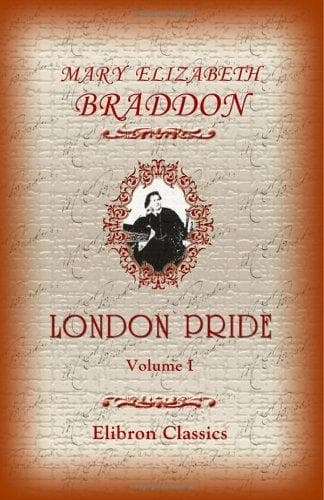
London Pride, Or, When the World Was YoungerBraddon, M. E. (Mary Elizabeth)
History
London Pride, Or, When the World Was Younger
Braddon, M. E. (Mary Elizabeth)
Great Britain -- History -- Charles II, 1660-1685 -- Fiction; London (England) -- Fiction
“Ay, with your sister, whom he has courted assiduously; but with no
honourable motive! I have seen his designs.”
“Well, perhaps you are right. He may care for Angela—and think her too
poor to marry.”
“He is a traitor and a villain——”
“Oh, what fury! Marry my sister to Sir Denzil, and then she will be
safe from all pursuit! He will bury her alive in Oxfordshire—withdraw
her for ever from this wicked town—like poor Lady Yarborough in
Cornwall.”
“I will never ask her to marry a man she cannot love.”
“Why not? Are not you and I a happy couple? And how much love had we
for each other before we married? Why I scarce knew the colour of your
eyes; and if I had met you in the street, I doubt if I should have
recognised you! And now, after thirteen years of matrimony, we are at
our first quarrel, and that no lasting one. Come, Fareham, be pleasant
and yielding. Let me go and see my old playfellow. I am heartbroken for
lack of his company, for fear of his death.”
She hung upon him coaxingly, the bright blue eyes looking up at
him—eyes that had so often been compared to Madame de Longueville’s,
eyes that had smiled and beamed in many a song and madrigal by the
parlour poets of the Hôtel de Rambouillet. She was exquisitely pretty
in her youthful colouring of lilies and roses, blue eyes, and pale gold
hair, and retained at thirty almost all the charms and graces of
eighteen.
Fareham took her by both hands and held her away from him, severely
scrutinising a face which he had always been able to admire as calmly
as if it had been on canvas.
“You look like an innocent woman,” he said, “and I have always believed
you a good woman; and have trusted my honour in your keeping—have seen
that man fawning at your feet, singing and sighing in your ear, and
have thought no evil. But now that you have told me, as plainly as
woman can speak to man, that this is the man you love, and have loved
all your life, there must needs come an end to the sighing and singing.
You and Henri de Malfort must meet no more. Nay, look not such angry
scorn. I impute no guilt; but between innocence and guilt there need be
but one passionate hour. The wife goes out an honest woman, able to
look her husband in the face as you are looking at me; the wanton comes
home, and the rest of her life is a shameful lie. And the husband
awakes some day from his dream of domestic peace to discover that he
has been long the laughing-stock of the town. I will be no such fatuous
husband, Hyacinth. I will wait for no second warning.”
Lady Fareham submitted in silence, and with deep resentment. She had
never before experienced a husband’s authority sternly exercised. She
had been forbidden the free run of London play-houses, and some of the
pleasures of Court society; but then she had been denied with all
kindness, and had been allowed so many counterbalancing extravagances,
pleasures, and follies, that it would have been difficult for her to
think herself ill-used.
Public-domain text, read in full here on John Shaqi.
Reviews
Reviews
No reviews yet
Be the first to share your thoughts on this work.
Elsewhere in the archive
Join the Discussion
Join the discussion
Sign in to leave a comment or review.
Sign InorCreate an account