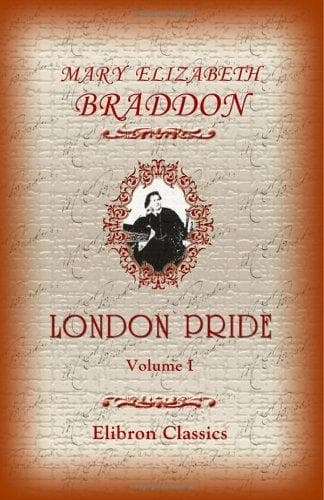
London Pride, Or, When the World Was YoungerBraddon, M. E. (Mary Elizabeth)
History
London Pride, Or, When the World Was Younger
Braddon, M. E. (Mary Elizabeth)
Great Britain -- History -- Charles II, 1660-1685 -- Fiction; London (England) -- Fiction
When she had read these last words, she crushed the letter in her palm,
clenching her fingers over it till the nails wounded the delicate
flesh; and then she opened her hand, and employed herself in smoothing
out the crumpled paper, as if her life depended on making the letter
readable again. But her pains could not undo what her passion had done;
and finding this, she tossed the ragged paper into the flames, and
began to walk about the room in a distracted fashion, giving a little
hysterical cry every now and then, and clasping her hands upon her
forehead.
Anger, humiliation, wounded love, wounded vanity, disappointment,
disillusion, were all in that cry, and in the passionate beating of her
heart, her stifled breath, her clenched hands.
“He was laughing when he wrote that letter—I am sure he was laughing.
There was not one serious moment, not one pang at leaving me! He has
been laughing at me ever since he came to London. I have been his fool,
his amusement. Other women have had his love, the guilty love that he
praises! He has come to me straight from their wicked houses, their
feasting, and riot, and drunkenness—has come and pretended to love
poetry, and Scudéry’s romances, and music, and innocent
conversation—come to rest himself after dissolute pleasures, bringing
me the leavings of that hellish company! And I have reviled such women,
and he has pretended an equal horror of them; and he was their slave
all the time, and went from me to them, and made a jest of me for their
amusement I know his biting raillery. And he was at the play-house day
after day, where I could not go, sitting side by side with his
Jezebels, laughing at filthy comedies, and at me that was forbidden to
appear there. He had pleasures of which I knew nothing; and when I
fancied our inmost souls moved in harmony, his thoughts were full of
wanton women and their wanton jests, and he smiled at my childishness,
and fooled me as children are fooled.”
The thought was distraction. She plucked out handfuls of her pale gold
hair, the pretty blonde hair which had been almost as famous in Paris
as Beaufort’s or Madame de Longueville’s yellow locks. The thought of
De Malfort’s ridicule cut her like a whalebone whip. She had fancied
herself his Beatrice, his Laura, his Stella—a being to be worshipped as
reverently as the stars, to make her lover happy with smiles and kindly
words, to stand for ever a little way off, like a goddess in her
temple, yet near enough to be adored.
And fondly believing this to be her mission, having posed for the
character, and filled it to her own fancy, she found that she had only
been a dissolute man’s dupe all the time; and no doubt had been the
laughing-stock of her acquaintance, who looked at the game.
“And I was so proud of his devotion—I carried my slave everywhere with
me. Oh, fool, fool, fool!”
Public-domain text, read in full here on John Shaqi.
Reviews
Reviews
No reviews yet
Be the first to share your thoughts on this work.
Elsewhere in the archive
Join the Discussion
Join the discussion
Sign in to leave a comment or review.
Sign InorCreate an account