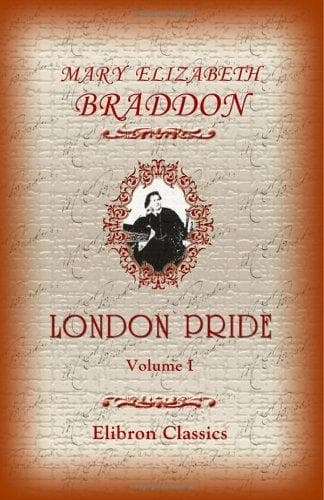
London Pride, Or, When the World Was YoungerBraddon, M. E. (Mary Elizabeth)
History
London Pride, Or, When the World Was Younger
Braddon, M. E. (Mary Elizabeth)
Great Britain -- History -- Charles II, 1660-1685 -- Fiction; London (England) -- Fiction
And then—the poor little brains being disordered by passionate
regrets—wickedest ideas ran riot in the confusion of a mind not wide
enough to hold life’s large passions. She began to be sorry that she
was not like those other women—to hate the modesty that had lost her a
lover.
To be like Barbara Castlemaine! That was woman’s only royalty. To rule
with sovereign power over the hearts and senses of men. A King for her
lover, constant in inconstancy, always going back to her from every
transient fancy—her property, her chattel; and the foremost wits and
dandies of the age for her servants, her Court of adorers, whom she
ruled with frowns or smiles, as her humour prompted. To be daring,
profuse, reckless, tyrannical; to suffer no control of heaven or
men—yes, that was, indeed, to be a Queen! And compared with such
empire, the poor authority of the Précieuse, dictating the choice of
adjectives, condemning pronouns, theorising upon feelings and passions
of which in practice she knows nothing, was a thing for scornfullest
laughter.
CHAPTER XX.
PHILASTER.
January was nearly over, the memorial service for the martyred King was
drawing near, and royalty and fashion had deserted Whitehall for
Hampton Court; yet the Farehams lingered at their riverside mansion.
His lordship had business in London, while Sir Denzil Warner, who came
to Fareham House daily, was also detained in the city by some special
attraction, which made hawk and hound, and even his worthy mother’s
company, indifferent to him.
Lady Fareham had an air of caring for neither town nor country, but on
the whole preferred town.
“London has become a positive desert—and the smoke from the smouldering
ruins poisons the garden and terrace whenever there is an east wind,”
she complained. “But Oxfordshire would be a worse desert—and I believe
I should die of the spleen in a week, if I trusted myself in that great
rambling Abbey. I can just suffer life in London; so I suppose I had
best stay till his lordship has finished his business, about which he
is so secret and mysterious.”
Denzil was more devoted, more solicitous to please than ever; and had a
better chance of pleasing now that most of her ladyship’s fine visitors
had left town. He read aloud to Hyacinth and her sister as they
worked—or pretended to work—at their embroidery frames. He played the
organ, and sang duets with Angela. He walked with her on the terrace,
in the cold, bleak afternoon, and told her the news of the town—not the
scandals and trivialities which alone interested Lady Fareham, but the
graver facts connected with the state and the public welfare—the
prospects of war or peace, the outlook towards France and Spain,
Holland and Sweden, Andrew Marvel’s last speech, or the last grant to
the King, who might be relied on to oppose no popular measure when his
lieges were about to provide a handsome subsidy or an increase of his
revenue.
“We are winning our liberties from him,” Denzil said.
Public-domain text, read in full here on John Shaqi.
Reviews
Reviews
No reviews yet
Be the first to share your thoughts on this work.
Elsewhere in the archive
Join the Discussion
Join the discussion
Sign in to leave a comment or review.
Sign InorCreate an account