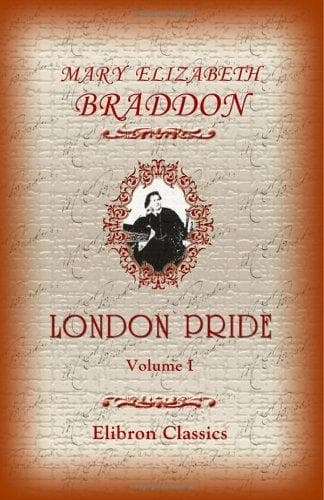
London Pride, Or, When the World Was YoungerBraddon, M. E. (Mary Elizabeth)
History
London Pride, Or, When the World Was Younger
Braddon, M. E. (Mary Elizabeth)
Great Britain -- History -- Charles II, 1660-1685 -- Fiction; London (England) -- Fiction
What was her poor life worth—so lonely even in her sister’s house—so
desolate when his eyes looked not upon her in kindness? After having
lived for two brief summers and winters in his cherished company,
having learnt to know what a proud, honourable man was like, his
disdain of vice, his indifference to Court favour, his aspirations for
liberty; after having known him, and loved him with silent and secret
love, what better could she do than bury herself within convent walls,
and spend the rest of her days in praying for those she loved? Alas, he
had such need that some faithful soul should soar heavenward in
supplication for him who had himself so weak a hold upon the skies!
Alas, to think of him as unbelieving, putting his trust in the opinions
of infidels like Hobbes and Spinoza, rather than leaning on that Rock
of Ages the Church of St. Peter.
If she could not live for him—if it were a sin even to dwell under the
same roof with him—she could at least die for him—die to the world of
pleasure and folly, of beauty and splendour, die to friendship and
love; sink all individuality under the monastic rule; cease to be,
except as a part in a great organisation, an atom acting and acted upon
by higher powers; surrendering every desire and every hope that
distinguished her from the multitude of women vowed to a holy life.
“Never, sir, will I
Marry; it is a thing within my vow.”
The voice of the actress sounded silver-clear as Bellario spoke her
last speech, finishing her story of a love which can submit to take the
lower place, and asks but little of fate.
“It is a thing within my vow.”
The line repeated itself in Angela’s mind as Denzil met them at the
door, and handed her into the coach.
Should she prove of weaker stuff than the sad Eufrasia, and accept a
husband she did not love? This humdrum modern age allowed of no
romance. She could not stain her face with walnut juice, and disguise
herself as a footboy, and live unknown in his service, to wait upon him
when he was weary, to nurse him when he was sick. Such a life she would
have deemed exquisitely happy; but the hard everyday world had no room
for such dreams. In this unromantic age Dion’s daughter would be
recognised within twenty-four hours of her putting on male attire. The
golden days of poetry were dead. Una would find no lion to fawn at her
feet. She would be mobbed in the Strand.
“Oh, that it could have been!” thought Angela, as the coach jolted and
rumbled through the narrow ways, and shaved awkward corners with its
ponderous wheels, and got its horses entangled with other noble teams,
to the provocation of much ill-language from postillions, and flunkeys,
and linkmen, for it was dark when they came out of the theatre, and a
thick mist was rising from the river, and flambeaux were flaring up and
down the dim narrow thoroughfares.
“They light the streets better in Paris,” complained Hyacinth. “In the
Rue de Touraine we had a lamp to every house.”
Public-domain text, read in full here on John Shaqi.
Reviews
Reviews
No reviews yet
Be the first to share your thoughts on this work.
Elsewhere in the archive
Join the Discussion
Join the discussion
Sign in to leave a comment or review.
Sign InorCreate an account