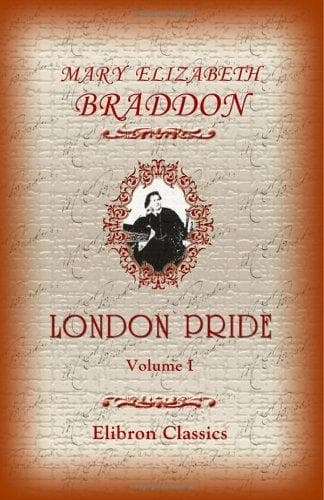
London Pride, Or, When the World Was YoungerBraddon, M. E. (Mary Elizabeth)
History
London Pride, Or, When the World Was Younger
Braddon, M. E. (Mary Elizabeth)
Great Britain -- History -- Charles II, 1660-1685 -- Fiction; London (England) -- Fiction
“I like to see the links moving up and down,” said Papillon; “’tis ever
so much prettier than lanterns that stand still—like that one at the
corner.”
She pointed to a small round lamp that made a bubble of light in an
abyss of gloom.
“Here the lamps stink more than they light,” said Hyacinth. “How the
coach rocks—those blockheads will end by upsetting it. I should have
been twice as well in my chair.”
Angela sat in her place, lost in thought, and hardly conscious of the
jolting coach, or of Papillon’s prattle, who would not be satisfied
till she had dragged her aunt into the conversation.
“Did you not love the play, and would you not love to be a princess
like Arethusa, and to wear such a necklace? Mother’s diamonds are not
half as big.”
“Pshaw, child, ’twas absolute glass—arrant trumpery.”
“But her gown was not trumpery. It was Lady Castlemaine’s last birthday
gown. I heard a lady telling her friend about it in the seat next mine.
Lady Castlemaine gave it to the actress; and it cost three hundred
pounds—and Lady Castlemaine is all that there is of the most
extravagant, the lady said, and old Rowley has to pay her debts—(who is
old Rowley, and why does he pay people’s debts?)—though she is the most
unscrupulous—I forget the word—in London.”
“You see, madam, what a good school the play-house is for your child,”
said Fareham grimly.
“I never asked you to take our child there.”
“Nay, Hyacinth; but a mother should enter no scene unfit for her
daughter’s innocence.”
“Oh, my lord, your opinions are of the Protectorate. You would be
better in New England—tilling your fields reclaimed from the waste.”
“Yes, I might be better there, reclaimed from the waste—of London life.
Strange that your talk should hit upon New England. I was thinking of
that New World not an hour ago at the play—thinking what a happy
innocent life a man might lead there, were he but young and free, with
one he loved.”
“Innocent, yes; happy, no; unless he were a savage or a peasant,”
Hyacinth exclaimed disdainfully. “We that have known the grace and
beauty of life cannot go back to the habits of our ancestors, to eat
without forks, and cover our floors with rushes instead of Persian
carpets.”
“The beauty and grace of life—houses that are whited sepulchres,
banquets where there is no love.”
The coach stopped before the tall Italian doorway, and Fareham handed
out his wife and sister in silence; but there was one of the party to
whom it was unnatural to be mute.
Papillon sprang off the coach step into her father’s arms.
“Sweetheart, why are you so sad?” she asked. “You look more unhappy
than Philaster when he thought his lady loved him not.”
She would not be put off, but hung about him all the length of the
corridor, to the door of his room, where he parted from her with a kiss
on her forehead.
Public-domain text, read in full here on John Shaqi.
Reviews
Reviews
No reviews yet
Be the first to share your thoughts on this work.
Elsewhere in the archive
Join the Discussion
Join the discussion
Sign in to leave a comment or review.
Sign InorCreate an account