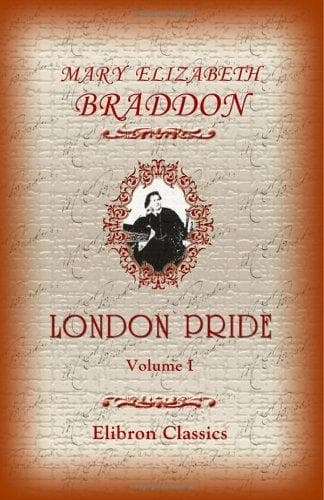
London Pride, Or, When the World Was YoungerBraddon, M. E. (Mary Elizabeth)
History
London Pride, Or, When the World Was Younger
Braddon, M. E. (Mary Elizabeth)
Great Britain -- History -- Charles II, 1660-1685 -- Fiction; London (England) -- Fiction
“I beseech your pardon and indulgence for my rough words of this
morning. God forbid that I should impute one unworthy thought to her
whose virtues I honour above all earthly merit. If your heart inclines
towards one whom it were misery for you to love, I know that it must be
with an affection pure and ethereal as the love of the disguised girl
in Fletcher’s play. But, ah, dearest angel, you know not the peril in
which you walk. Your innocent mind cannot conceive the audacious height
to which unholy love may climb in a man’s fiery nature. You cannot
fathom the black depths of such a character as Fareham—a man as capable
of greatness in evil as of distinction in good. Forget not whose fierce
blood runs in those veins. Can you doubt his audacity in wrong-doing,
when you remember that he comes of the same stock which produced that
renegade and tyrant, Thomas Wentworth—a man who would have waded deep
in the blood of a nation to reach his desired goal, all the history of
whose life was expressed by him in one word—‘thorough’?
“Do you consider what that word means to a man over whose heart sin has
taken the upper hand? Thorough! How resolute in evil, how undaunted and
without limit in baseness, is he who takes that word for his motto! Oh,
my love, there are dragons and lions about thy innocent footsteps—the
dragons of lust, the lions of presumptuous love. Flee from thy worst
enemy, dearest, to the shelter of a heart which adores thee; lean upon
a breast whose pulses beat for thee with a truth that time cannot
change.
“Thine till death,
“WARNER.”
Angela tore up the letter in anger. How dared he write thus of Lord
Fareham? To impute sinful passions, guilty desires—to enter into
another man’s mind, and read the secret cipher of his thoughts and
wishes with an assumed key, which might be false? His letter was a
bundle of false assumptions. What right had he to insist that her
brother-in-law cared for her with more than the affection authorised by
affinity? He had no right. She hated him for his insolent letter. She
scorned the protection of his love. She had her refuge and her shelter
in a holier love than his. The doors of the old home would open to her
at a word.
Public-domain text, read in full here on John Shaqi.
Reviews
Reviews
No reviews yet
Be the first to share your thoughts on this work.
Elsewhere in the archive
Join the Discussion
Join the discussion
Sign in to leave a comment or review.
Sign InorCreate an account