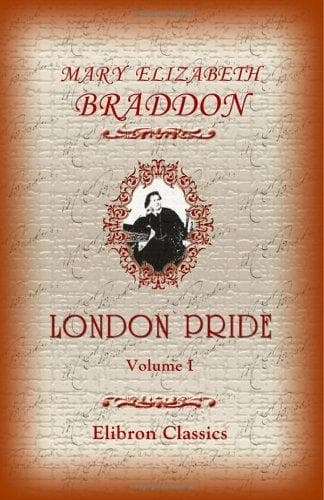
London Pride, Or, When the World Was YoungerBraddon, M. E. (Mary Elizabeth)
History
London Pride, Or, When the World Was Younger
Braddon, M. E. (Mary Elizabeth)
Great Britain -- History -- Charles II, 1660-1685 -- Fiction; London (England) -- Fiction
“What! never a sigh for London pleasures? Thou hast the great lady’s
air and carriage in that brave blue taffety. The nun I knew three years
ago has vanished. Can you so lightly renounce the splendour of this
house, and your sister’s company, to make a prosing old father happy?”
“Indeed, sir, I am ready to go with you.”
“How she says that—with what a countenance of woeful resignation! But I
will not make the Manor Moat too severe a prison, dearest. You shall
visit London, and your sister, when you will. There shall be a coach
and a team of stout roadsters to pull it when they are not wanted for
the plough. And the Vale of Aylesbury is but a long day’s journey from
London, while ’tis no more than a morning’s ride to Chilton.”
“I could not bear for her to be long away from me,” said Hyacinth. “She
is the only companion I have in the world.”
“Except your husband.”
“Husbands such as mine are poor company. Fareham has a moody brow, and
a mind stuffed with public matters. He dines with Clarendon one day,
and with Albemarle another; or he goes to Deptford to grumble with Mr.
Evelyn; or he creeps away to some obscure quarter of the town to
hob-nob with Milton, and with Marvel, the member for Hull. I doubt they
are all of one mind in abusing his Majesty, and conspiring against him.
If I lose my sister I shall have no one.”
“What, no one; when you have Henriette, who even three years ago had
shrewdness enough to keep an old grandfather amused with her
impertinent prattle?”
“Grandfathers are easily amused by children they see as seldom as you
have seen Papillon. To have her about you all day, with her everlasting
chatter, and questions, and remarks, and opinions (a brat of twelve
with opinions), would soon give you the vapours.”
“I am not so subject to vapours as you, child. Let me look at you, now
the candles are lighted.”
The footmen had lighted clusters of wax candles on either side the tall
chimney-piece.
Sir John drew his elder daughter to the light, and scrutinised her face
with a father’s privilege of uncompromising survey.
“You paint thick enough, i’ conscience’ name, though not quite so thick
as the Spanish señoras. They are browner than you, and need a heavier
hand with white and red. But you are haggard under all your red. You
are not the woman I left in ’65.”
“I am near two years older than the woman you left; and as for paint,
there is not a woman over twenty in London who uses as little red and
white as I do.”
“What has become of Fareham to-night?” Sir John asked presently, when
Hyacinth had picked up her favourite spaniel to nurse and fondle, while
Angela had resumed her occupation at an embroidery frame, and a
reposeful air as of a long-established domesticity had fallen upon the
scene.
“He is at Chilton. When he is not plotting he rushes off to Oxfordshire
for the hunting and shooting. He loves buglehorns and yelping curs, and
huntsmen’s cracked voices, far before the company of ladies or the
conversation of wits.”
Public-domain text, read in full here on John Shaqi.
Reviews
Reviews
No reviews yet
Be the first to share your thoughts on this work.
Elsewhere in the archive
Join the Discussion
Join the discussion
Sign in to leave a comment or review.
Sign InorCreate an account