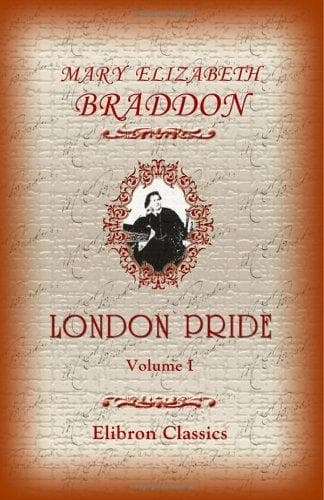
London Pride, Or, When the World Was YoungerBraddon, M. E. (Mary Elizabeth)
History
London Pride, Or, When the World Was Younger
Braddon, M. E. (Mary Elizabeth)
Great Britain -- History -- Charles II, 1660-1685 -- Fiction; London (England) -- Fiction
Her heart yearned towards the old house, so distinctly pictured by
memory, though perchance with some differences from the actual scene.
The mansion would seem smaller to her, doubtless, beholding it with the
eyes of womanhood, than childish memory made it. But to live there with
her father, to wait upon him and tend him, to have Hyacinth’s children
there, playing in the gardens as she had played, would be as happy a
life as her fancy could compass.
All that she knew of the march of events during those tranquil years in
the convent came to her in letters from her sister, who was a vivacious
letter-writer, and prided herself upon her epistolary talent—as indeed
upon her general superiority, from a literary standpoint, to the women
of her day.
It was a pleasure to Lady Fareham in some rare interval of
solitude—when the weather was too severe for her to venture outside the
hall door, even in her comfortable coach, and when by some curious
concatenation she happened to be without visitors—to open her portfolio
and prattle with her pen to her sister, as she would have prattled with
her tongue to the visitors whom snow or tempest kept away. Her letters
written from London were apt to be rare and brief, Angela noted; but
from his lordship’s mansion near Oxford, or at the Grange between
Fareham and Winchester—once the property of the brothers of St.
Cross—she always sent a budget. Few of these lengthy epistles contained
anything bearing upon Angela’s own existence—except the oft-repeated
entreaty that she would make haste and join them—or even the flippant
suggestion that Mother Anastasia should make haste and die. They were
of the nature of news-letters; but the news was tinctured by the
feminine medium through which it came, and there was a flavour of
egotism in almost every page. Lady Fareham wrote as only a pretty
woman, courted, flattered, and indulged by everybody about her, ever
since she could remember, could be forgiven for writing. People had
petted her and worshipped her with such uniform subservience that she
had grown to thirty years of age without knowing that she was selfish,
accepting homage and submission as a law of the universe, as kings and
princes do.
Only in one of those letters was there that which might be called a
momentous fact, but which Angela took as easily as if it had been a
mere detail, to be dismissed from her thoughts when the letter had been
laid aside.
Public-domain text, read in full here on John Shaqi.
Reviews
Reviews
No reviews yet
Be the first to share your thoughts on this work.
Join the Discussion
Join the discussion
Sign in to leave a comment or review.
Sign InorCreate an account