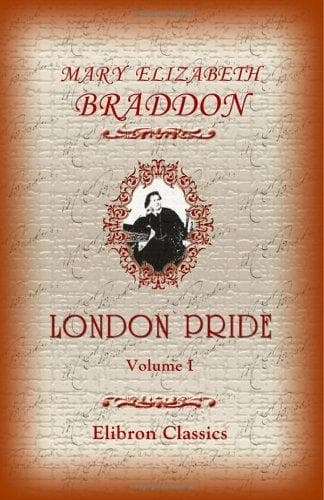
London Pride, Or, When the World Was YoungerBraddon, M. E. (Mary Elizabeth)
History
London Pride, Or, When the World Was Younger
Braddon, M. E. (Mary Elizabeth)
Great Britain -- History -- Charles II, 1660-1685 -- Fiction; London (England) -- Fiction
“I found such shame as never came before upon England, such confusion
as only traitors and profligates can know; men who have cheated and
lied and wasted the public money, left our fortresses undefended, our
ships unarmed, our sailors unpaid, half-fed, and mutinous; clamorous
wives crying aloud in the streets that their husbands should not fight
and bleed for a King who starved them. They have clapped the scoundrel
who had charge of the Yard at Chatham in the Tower—but will that mend
matters? A scapegoat, belike, to suffer for higher scoundrels. The mob
is loudest against the Chancellor, who I doubt is not to blame for our
unreadiness, having little power of late over the King. Oh, there has
been iniquity upon iniquity, and men know not whom most to blame—the
venal idle servants, or the master of all.”
“You mean that men blame his Majesty?”
“No, Angela. But when our ships were blazing at Chatham, and the Dutch
triumphing, the cry was ‘Oh, for an hour of old Noll!’ Charles has
played his cards so that he has made the loyalest hearts in England
wish the Brewer back again. They called him the Tiger of the Seas. We
have no tigers now, only asses and monkeys. Why, there was scarce a
grain of sense left in London. The beat of the drums calling out the
train-bands seemed to have stupefied the people. Everywhere madness and
confusion. They have sunk their richest argosies at Barking Creek to
block the river; but the Dutch break chains, ride over sunken ships,
laugh our petty defences to scorn.”
“Dear sir, this confusion cannot last.”
“It will last as long as the world’s history lasts. Our humiliation
will never be forgotten.”
“But Englishmen will not look on idle. There must be brave men up in
arms.”
“Oh, there are brave men enough—Fairfax, Ingoldsby, Bethell, Norton.
The Presbyterians come to the front in our troubles. Your
brother-in-law is with Lord Middleton. There is no lack of officers;
and regiments are being raised. But our merchant-ships, which should be
quick to help us, hang back. Our Treasury is empty, and half the
goldsmiths in London are bankrupt. And our ships that are burnt, and
our ships that are taken, will not be conjured back again. The _Royal
Charles_ carried off with insulting triumph! Oh, child, it is not the
loss that galls; it is the dishonour!”
He took a draught of claret out of the tankard which Angela placed at
his elbow, and she carved the ham for him, and persuaded him to eat.
“Is it the public misfortune that troubles you so sadly, sir?” she
asked, presently, when her father flung himself back in his chair with
a heavy sigh.
“Nay, Angela, I have my peck of trouble without reckoning the ruin of
my country. But my back is broad. It can bear a burden as well as any.”
“Do you count a disobedient daughter among your cares, sir?”
“Disobedient is too harsh a word. I told you I would never force your
inclinations. But I have an obstinate daughter, who has disappointed
me, and well-nigh broken my spirit.”
Public-domain text, read in full here on John Shaqi.
Reviews
Reviews
No reviews yet
Be the first to share your thoughts on this work.
Elsewhere in the archive
Join the Discussion
Join the discussion
Sign in to leave a comment or review.
Sign InorCreate an account