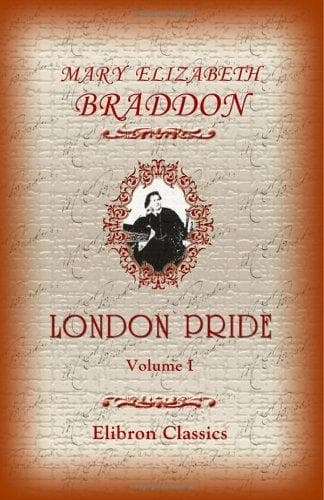
London Pride, Or, When the World Was YoungerBraddon, M. E. (Mary Elizabeth)
History
London Pride, Or, When the World Was Younger
Braddon, M. E. (Mary Elizabeth)
Great Britain -- History -- Charles II, 1660-1685 -- Fiction; London (England) -- Fiction
“Your spirit shall not rest broken if my obedience can mend it, sir,”
she said gently, dropping on her knees beside his chair.
“What! has that stony heart relented! Wilt thou marry him, sweetheart?
Wilt give me a son as well as a daughter, and the security that thou
wilt be safe and happy when I’m gone?”
“No one can be sure of happiness, father; it comes strangely, and goes
we know not why. But if it will make your heart easier, sir, and Denzil
be still of the same mind——”
“His mind his rock, dearest. He swore to me that he could never change.
Ah, love, you have made me happy! Let the fleet burn, the _Royal
Charles_ fly Dutch colours. Here, in this quiet valley, there shall be
a peaceful household and united hearts. Angela, I love that youth!
Fareham, with all his rank and wealth, has never been so dear to me.
That black visage repels love. But Denzil’s countenance is open as the
day. I can say ‘Nunc Dimittis’ with a light heart. I can trust Denzil
Warner with my daughter’s happiness.”
CHAPTER XXIV.
“QUITE OUT OF FASHION.”
Denzil received the good news by the hands of a mounted messenger in
the following forenoon.
The Knight had written, “Ride—ride—ride!” in the Elizabethan style, on
the cover of his letter, which contained but two brief sentences—
“Womanlike, she has changed her mind. Come when thou wilt, dear son.”
And the son-in-law-to-be lost not an hour. He was at the Manor before
night-fall. He was a member of the quiet household again, subservient
to his mistress in everything.
“There are some words that must needs be spoken before we are agreed,”
Angela said, when they found themselves alone for the first time, in
the garden, on the morning after his return, and when Denzil would fain
have taken her to his breast and ratified their betrothal with a kiss.
“I think you know as well as I do that it is my father’s wish that has
made me change.”
“So long as you change not again, dear, I am of all men the happiest.
Yes, I know ’tis Sir John’s wooing that won you, not mine. And that I
have still to conquer your heart, though your hand is promised me. Yet
I do not despair of being loved in as full measure as I love. My faith
is strong in the power of an honest affection.”
“You may at least be sure of my honesty. I profess nothing but the
desire to be your true and obedient wife——”
“Obedient! You shall be my empress.”
“No, no. I have no wish to rule. I desire only to make my father happy,
and you too, sir, if I can.”
“Ah, my soul, that is so easy for you. You have but to let me live in
your dear company. I doubt I would rather be miserable with you than
happy with any other woman. Ill-use me if you will; play Zantippe, and
I will be more submissive than Socrates. But you are all
mildness—perfect Christian, perfect woman. You cannot miss being
perfect as wife—and——”
Another word trembled on his lips; but he checked himself lest he
should offend, and the speech ended in a sob.
“My Angela, my angel!”
Public-domain text, read in full here on John Shaqi.
Reviews
Reviews
No reviews yet
Be the first to share your thoughts on this work.
Elsewhere in the archive
Join the Discussion
Join the discussion
Sign in to leave a comment or review.
Sign InorCreate an account