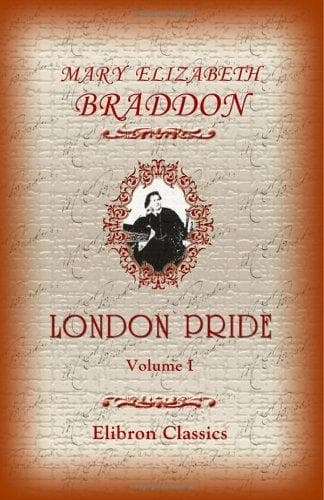
London Pride, Or, When the World Was YoungerBraddon, M. E. (Mary Elizabeth)
History
London Pride, Or, When the World Was Younger
Braddon, M. E. (Mary Elizabeth)
Great Britain -- History -- Charles II, 1660-1685 -- Fiction; London (England) -- Fiction
Foreign adventure had followed English hardships, and the soldier had
been tossed on the stormy sea of European warfare. He had been
graciously received at the French Court, but only to feel himself a
stranger there, and to have his English clothes and English accent
laughed at by Gramont and Bussy, and the accomplished St. Évremond, and
the frivolous herd of their imitators; to see even the Queen, for whom
he had spent his last jacobus, smile behind her fan at his bévues, and
whisper to her sister-in-law while he knelt to kiss the little white
hand that had led a King to ruin. Everywhere the stern Malignant had
found himself outside the circle of the elect. At the Hôtel de
Rambouillet, in the splendid houses of the newly built Place Royale, in
the salons of Duchesses, and the taverns of courtly roysterers and
drunken poets, at Cormier’s, or at the Pine Apple, in the Rue de la
Juiverie, where it was all the better for a Christian gentleman not to
understand the talk of the wits that flashed and drank there.
Everywhere he had been a stranger and aloof. It was only under canvas,
in danger and privation, that he lost the sense of being one too many
in the world. There John Kirkland found his level, shoulder to shoulder
with Condé and Turenne. The stout Cavalier was second to no soldier in
Louis’ splendid army; was of the stamp of an earlier race even, better
inured to hardship than any save that heroic Prince, the Achilles of
his day, who to the graces of a modern courtier joined the temper of an
ancient Greek.
His daughter Hyacinth had given him the utmost affection which such a
nature could give; but it was the affection of a trained singing-bird,
or a pug-nosed spaniel; and the father, though he admired her beauty,
and was pleased with her caresses, was shrewd enough to perceive the
lightness of her disposition and the shallowness of her mind. He
rejoiced in her marriage with a man of Fareham’s strong character.
“I have married thee to a husband who will know how to rule a wife,” he
told her on the night of her wedding. “You have but to obey and to be
happy; for he is rich enough to indulge all your fancies, and will not
complain if you waste the gold that would pay a company of foot on the
decoration of your poor little person.”
“The tone in which you speak of my poor little person, sir, can but
remind me how much I need the tailor and the milliner,” answered
Hyacinth, dropping her favourite curtsy, which she was ever ready to
practise at the slightest provocation.
“Nay, petite chatte, you know I think you the loveliest creature at
Saint Germain or the Louvre, far surpassing in beauty the Cardinal’s
niece, who has managed to set young Louis’ heart throbbing with a
boyish passion. But I doubt you bestow too much care on the cherishing
of a gift so fleeting.”
Public-domain text, read in full here on John Shaqi.
Reviews
Reviews
No reviews yet
Be the first to share your thoughts on this work.
Elsewhere in the archive
Join the Discussion
Join the discussion
Sign in to leave a comment or review.
Sign InorCreate an account