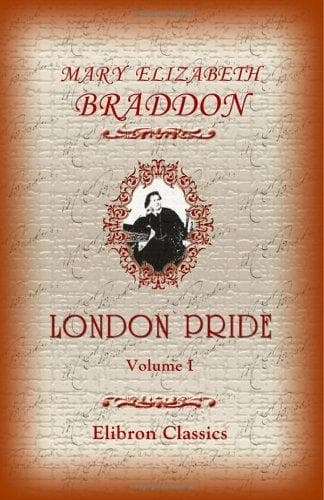
London Pride, Or, When the World Was YoungerBraddon, M. E. (Mary Elizabeth)
History
London Pride, Or, When the World Was Younger
Braddon, M. E. (Mary Elizabeth)
Great Britain -- History -- Charles II, 1660-1685 -- Fiction; London (England) -- Fiction
“Never loved me. Her heart—that which she calls heart—was ever
Malfort’s and not mine. She gave me to know as much by a hundred signs
and tokens which read plain enough now, looking back, but which I
scarce heeded at the time. I believed her chaste, and she was civil,
and I was satisfied. I tell you, Angela, this heart never beat for
woman till I knew you. Ah, love, be not stone! Make not our affinity an
obstacle. The Roman Church will ever grant dispensation for a union of
affinities where there is cause for indulgence. The Church would have
had Philip married to his wife’s sister Elizabeth.”
“The Church holds the bond of marriage indissoluble,” Angela answered.
“You are married to my sister; and while she lives you can have no
other wife.”
Her brow was stern, her courage unfaltering; but physical force was
failing her. She leant against the door for support, and she no longer
struggled to withdraw her hands from that strong grasp which held them.
She fought against the faintness that was stealing over her senses; but
her heavy eyelids were beginning to droop, and there was a sound like
rushing water in her ears.
“Angela—Angela,” pleaded the tender voice, “do you forget that
afternoon at the play, and how you wept over Bellario’s fidelity—the
fond girl-page who followed him she loved; risked name and virtue;
counted not the cost, in that large simplicity of love which gives all
it has to give, unquestioning? Remember Bellario.”
“Bellario had no thought that was not virtue’s,” she answered faintly;
and he took that fainter tone for a yielding will.
“She would not have left Philaster if he had been alone in the
wilderness, miserable for want of her love.”
Her white lips moved dumbly, her eyelids sank, and her head fell back
upon his shoulder, as he started up from his knees to support her
sinking figure. She was in his arms, unconscious—the image of death.
He kissed her on the brow.
“My soul, I will owe nothing to thy helplessness,” he whispered. “Thy
free will shall decide whether I live or die.”
Another sound had mingled with the rushing waters as her senses left
her—the sound of knocking at a distant door. It grew louder and louder
momently, indicating a passionate impatience in those who knocked. The
sound came from the principal door, and there was a long corridor
between that door and Fareham’s room.
He stood listening, undecided; and then he laid the unconscious form
gently on the thick Persian carpet—knowing that for recovery the
fainting girl could not lie too low. He cast one agitated glance at the
white face looking up at the ceiling, and then went quickly to the
hall.
As he came near, the knocking began again, with greater vehemence, and
a voice, which he knew for Sir John’s, called—
“Open the door, in the King’s name, or we will break it open!”
There was a pause; those without evidently waiting for the result of
that last and loudest summons.
Public-domain text, read in full here on John Shaqi.
Reviews
Reviews
No reviews yet
Be the first to share your thoughts on this work.
Elsewhere in the archive
Join the Discussion
Join the discussion
Sign in to leave a comment or review.
Sign InorCreate an account