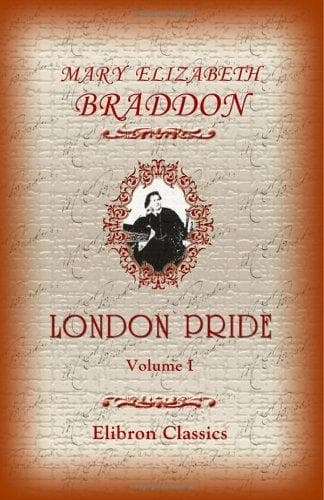
London Pride, Or, When the World Was YoungerBraddon, M. E. (Mary Elizabeth)
History
London Pride, Or, When the World Was Younger
Braddon, M. E. (Mary Elizabeth)
Great Britain -- History -- Charles II, 1660-1685 -- Fiction; London (England) -- Fiction
“I am growing almost as sober as my solemn spouse, who will ever be
railing at the King and the Duke, and even more bitterly at the
favourite, his Grace of Buckingham, who is assuredly one of the most
agreeable men in London. I asked Fareham only yesterday why he went to
Court, if his Majesty’s company is thus distasteful to him. ‘It is not
to his company I object, but to his principles,’ he answered, in that
earnest fashion of his which takes the lightest questions _au grand
serieux_. ‘I see in him a man who, with natural parts far above the
average, makes himself the jest of meaner intellects, and the dupe of
greedy courtesans; a man who, trained in the stern school of adversity,
overshadowed by the great horror of his father’s tragical doom, accepts
life as one long jest, and being, by a concatenation of circumstances
bordering on the miraculous, restored to the privileges of hereditary
monarchy, takes all possible pains to prove the uselessness of kings. I
see a man who, borne back to power by the irresistible current of the
people’s affections, has broken every pledge he gave that people in the
flush and triumph of his return. I see one who, in his own person,
cares neither for Paul nor Peter, and yet can tamely witness the
persecution of his people because they do not conform to a State
religion—can allow good and pious men to be driven out of the pulpits
where they have preached the Gospel of Christ, and suffer wives and
children to starve because the head of the household has a conscience.
I see a king careless of the welfare of his people, and the honour and
glory of his reign; affecting to be a patriot, and a man of business,
on the strength of an extravagant fancy for shipbuilding; careless of
everything save the empty pleasure of an idle hour. A king who lavishes
thousands upon wantons and profligates, and who ever gives not to the
most worthy, but to the most importunate.’
“I laughed at this tirade, and told him, what indeed I believe, that he
is at heart a Puritan, and would better consort with Baxter and Bunyan,
and that frousy crew, than with Buckhurst and Sedley, or his brilliant
kinsman, Roscommon.”
From her father directly, Angela heard nothing, and her sister’s
allusions to him were of the briefest, anxiously as she had questioned
that lively letter-writer. Yes, her father was well, Hyacinth told her;
but he stayed mostly at the Manor Moat. He did not care for the Court
gaieties.
Public-domain text, read in full here on John Shaqi.
Reviews
Reviews
No reviews yet
Be the first to share your thoughts on this work.
Join the Discussion
Join the discussion
Sign in to leave a comment or review.
Sign InorCreate an account