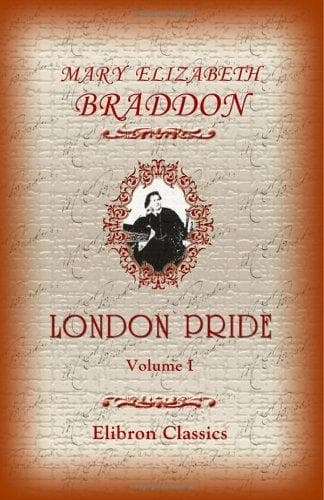
London Pride, Or, When the World Was YoungerBraddon, M. E. (Mary Elizabeth)
History
London Pride, Or, When the World Was Younger
Braddon, M. E. (Mary Elizabeth)
Great Britain -- History -- Charles II, 1660-1685 -- Fiction; London (England) -- Fiction
Here for the first time she beheld a saloon for whose decoration
palaces had been ransacked and churches desecrated—the stolen treasures
of many an ancestral mansion, spoil of rough soldiery or city rabble,
things that had been slyly stowed away by their possessors during the
stern simplicity of the Commonwealth, and had been brought out of their
hiding-places and sold to the highest bidder. Gold and silver had been
melted down in the Great Rebellion; but art treasures would not serve
to pay soldiers or to buy ammunition; so these had escaped the
melting-pot. At home and abroad the storehouses of curiosity merchants
had been explored to beautify Lady Fareham’s reception-rooms; and in
the fading light Angela gazed upon hangings that were worthy of a royal
palace, upon Italian crystals and Indian carvings, upon ivory and amber
and jade and jasper, upon tables of Florentine mosaic, and ebony
cabinets incrusted with rare agates, and upon pictures in frames of
massive and elaborate carving, Venetian mirrors which gave back the
dying light from a thousand facets, curtains and portières of sumptuous
brocade, gold-embroidered, gorgeous with the silken semblance of
peacock plumage, done with the needle, from the royal manufactory of
the Crown Furniture at the Gobelins.
She passed into an ante-room, with tapestried walls, and a divan
covered with raised velvet, a music desk of gilded wood, and a spinet,
on which was painted the story of Orpheus and Eurydice. Beyond this
there was the dining-room, more soberly though no less richly furnished
than the saloon. Here the hangings were of Cordovan leather, stamped
and gilded with _fleur-de-lys_, suggesting a French origin, and indeed
these very hangings had been bought by a Dutch Jew dealer in the time
of the Fronde, had belonged to the hated minister Mazarin, and had been
sold among other of his effects when he fled from Paris: to vanish for
a brief season behind the clouds of public animosity, and to blaze out
again, an elderly phoenix, in a new palace, adorned with new treasures
of art and industry that made royal princes envious.
Angela gazed on all this splendour as one bewildered. In front of that
gilded wall, quivering in mid-air, as if it had been painted upon the
shaft of light that streamed in from the tall window, her fancy
pictured the blood-red cross and the piteous legend, “Lord, have mercy
on us!” written in the same blood colour. For herself she had neither
horror of the pestilence nor fear of death. Religion had familiarised
her mind with the image of the destroyer. From her childhood she had
been acquainted with the grave, and with visions of a world beyond the
grave. It was not for herself she trembled, but for her sister, and her
sister’s children; for Lord Fareham, whose likeness she recalled even
at this moment, the grave dark face which Hyacinth had shown her on the
locket she wore upon her neck, the face which Sir John said reminded
him of Strafford.
Public-domain text, read in full here on John Shaqi.
Reviews
Reviews
No reviews yet
Be the first to share your thoughts on this work.
Join the Discussion
Join the discussion
Sign in to leave a comment or review.
Sign InorCreate an account