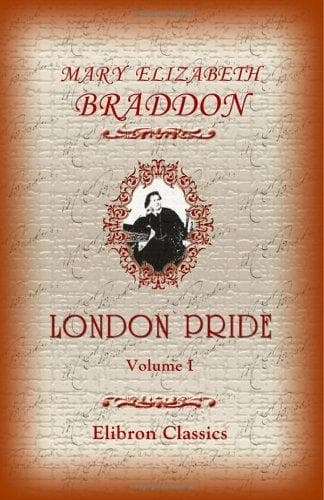
London Pride, Or, When the World Was Younger — John Shaqi
London Pride, Or, When the World Was YoungerBraddon, M. E. (Mary Elizabeth)
History
London Pride, Or, When the World Was Younger
Braddon, M. E. (Mary Elizabeth)
Great Britain -- History -- Charles II, 1660-1685 -- Fiction; London (England) -- Fiction
Angela knew that dark and powerful face at the first glance, though the
features were distorted by suffering. This sick man, the sole occupant
of a deserted mansion, was her brother-in-law, Lord Fareham. A large
high-backed armchair stood beside the bed, and on this Angela seated
herself. She recollected the Superior’s injunction just in time to put
one of the anti-pestilential lozenges into her mouth before she bent
over the sufferer, and took his clammy hand in hers, and endured the
acrimony of his poisonous breath. That anxious gaze, the dark yellow
complexion, and those great beads of sweat that poured down the pinched
countenance too plainly indicated the disease which had desolated
London. The Moslem’s invisible plague-angel had entered this palace,
and had touched the master with his deadly lance. That terrible
Presence, which for the most part had been found among the dwellings of
the poor, was here amidst purple and fine linen, here on this bed of
state, enthroned in ebony and silver, hung round with velvet and
bullion. She needed not to discover the pestilential spots beneath that
semi-diaphanous cambric which hung loose upon the muscular frame, to be
convinced of the cruel fact. Here, abandoned and alone, lay the master
of the house, with nothing better than a pair of spaniels for his
companions, and neither nurse nor watcher, wife nor friend, to help him
towards recovery, or to comfort his passing soul.
One of the little dogs leapt on the bed, and licked his master’s face
again and again, whining piteously between whiles.
The sick man looked at Angela with awful, unseeing eyes, and then burst
into a wild laugh—
“See them run, the crop-headed clod-hoppers!” he cried. “Ride after
them—mow them down—scatter the rebel clot-pols! The day is ours!” And
then, passing from English to French, from visions of Lindsey and
Rupert and the pursuit at Edgehill to memories of Condé and Turenne, he
shouted with the voice that was like the sound of a trumpet,
“_Boutte-selle! boutte-selle! Monte à cheval! monte à cheval! à l’arme,
à l’arme!_”
He was in the field of battle again. His wandering wits had carried him
back to his first fight, when he was a lad in his father’s company of
horse, following the King’s fortunes, breathing gunpowder, and splashed
with human blood for the first time—when it was not so long since he
had been blooded at the death of his first fox. He was a young man
again, with the Prince, that Bourbon prince and hero whom he loved and
honoured far above any of his own countrymen.
Public-domain text, read in full here on John Shaqi.
Reviews
Reviews
No reviews yet
Be the first to share your thoughts on this work.
Join the Discussion
Join the discussion
Sign in to leave a comment or review.
Sign InorCreate an account